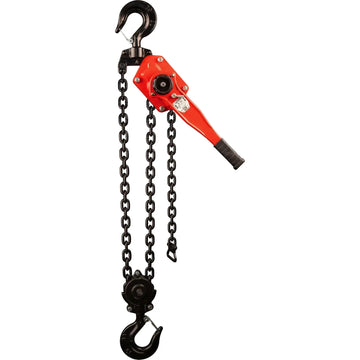
How to Choose a Lever Hoist
Start with rated capacity, and size it to the heaviest load you will actually lift, not the average. Rated capacity assumes a vertical lift on a sound anchor point; angled pulls, side loading and shock loading all add stress the rating does not cover. Next, set the lift height — the chain has to reach from your anchor to the load with slack to spare, and buying more lift than you need adds chain weight you carry to every job. Then look at handle effort and unit weight: a hoist that gets carried up a ladder or into a boom lift basket is a different purchase than one that lives on a shop rack.
Duty cycle matters more than most buyers expect. Occasional tensioning of a fence line or pulling a stump is light work; daily rigging in a fabrication shop or on a maintenance crew means the pawls, brake discs and load chain see cycles every shift, and the hoist should be specified accordingly.
What This Lever Hoists Collection Covers
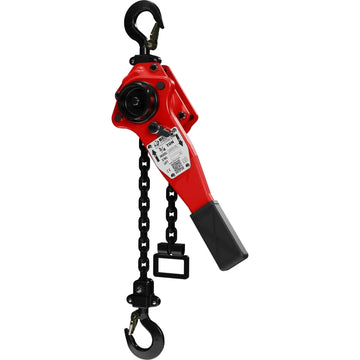
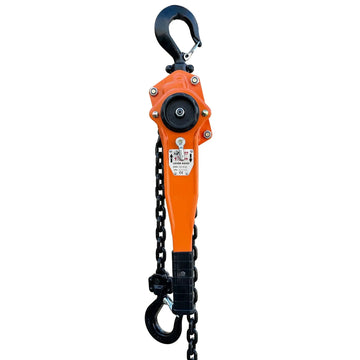
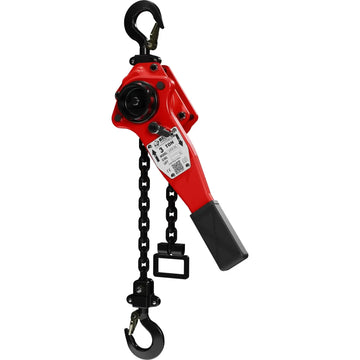
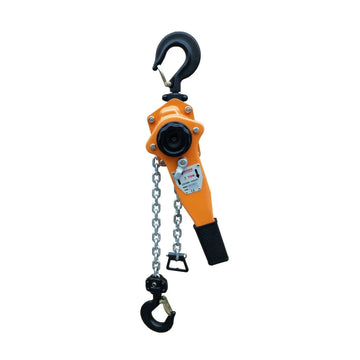
Thirteen lever hoists are listed here — nine from Bison Lifting and four Vestil series pages, each of which opens into a model table. The Vestil units are made in the USA by Vestil Manufacturing and carry a 1-Year Limited warranty; the Bison Lifting 6 Ton Lever Hoist with Overload Protection (LH60-OL) lists a 12-month warranty and ASME B30.21 compliance.
| Series | Capacity | Models listed | Price from |
|---|
| Vestil Compact & Lightweight (VKX) | 500 lb | 1 | $182.00 |
| Vestil Mighty Mini (ELH) | 500 – 5,000 lb | 7 | $186.16 |
| Vestil Economy (ELH) | 1,500 – 12,000 lb | 13 | $237.72 |
| Vestil Professional (PLH) | 1,500 – 12,000 lb | 12 | $272.00 |
| Bison Lifting lever hoists | 3/4, 1 1/2, 3 and 6 ton | 9 listings | See listing |
Lever Hoist vs. Chain Hoist vs. Come-Along
A lever hoist is operated by stroking a short handle back and forth, which lets it work in any orientation — vertical, horizontal or overhead at an angle — and makes it the usual choice for pulling and tensioning as well as lifting. A hand chain hoist is operated by pulling a loop of hand chain and is built for vertical lifting from a fixed overhead point; it is easier on the operator for long lifts but needs headroom and a hand chain that reaches the operator. A cable come-along uses wire rope on a drum and is a pulling tool. ASME B30.21 is the volume that covers lever hoists specifically, and a puller sold for horizontal pulling should not be substituted for a lifting hoist. If your work mixes overhead lifting with pulling — machinery moves, tensioning, alignment work — the lever hoist is the more flexible tool.
Brakes, Overload Protection and Load Chain
All four Vestil series listed here are disc brake designs. The Bison 6 Ton (LH60-OL) uses a dual pawl Weston-style load brake with high-grade alloy steel construction, and its overload protection is an integrated mechanical slip-clutch that prevents lifting beyond 125% of rated capacity. The Bison 3 Ton Overload Protection model lists an integrated system that disengages when the load exceeds rated capacity, running Grade 80 heat-treated alloy steel load chain. Overload protection is worth paying for where several operators share one hoist, or where the anchor point rather than the hoist is the limiting factor.
Chain finish is a durability choice, not a strength one. Bison lists 1 1/2 ton and 3 ton hoists with galvanized chain, and 1 1/2, 3 and 6 ton hoists with black chain; galvanized is the usual pick for outdoor, marine or washdown exposure, black chain for indoor shop use with routine lubrication. ASME B30.21 addresses load chain and hook inspection criteria for lever hoists.
Inspection, Training and Standards
ASME B30.21 covers lever hoists and addresses rated load marking, frequent and periodic inspection, and the criteria for removing a hoist from service. Related rigging falls under other volumes — ASME B30.10 covers hooks and ASME B30.26 covers rigging hardware such as shackles — while OSHA 1910.184 governs slings used with the hoist. Damaged equipment comes out of service: a stretched or gouged load chain, a deformed hook, a latch that will not close, or a brake that slips should be tagged out, not watched.
A practical routine before each use: check the hook and latch, run the chain through its full travel looking for twists, nicks and elongation, confirm the chain is not capsized on the load sheave, and test the brake with a short lift a few inches off the ground before committing the load. Keep the rated capacity tag legible — an unmarked hoist is a hoist nobody can size correctly.
What Buyers Get Wrong
Three mistakes come up repeatedly. The first is buying to the load weight exactly, with no margin for the rigging, the pull angle, or the fact that a stuck load resists far harder than it weighs. The second is cheating the handle with a pipe extension; handle length is part of the rating, and an extension is how people overload a hoist they believed was oversized. The third is ignoring the anchor — the beam, trolley, hitch or eyebolt has to be rated for the load, and a 6 ton hoist hung on an unrated anchor is a 6 ton problem. One more worth checking before you order: the hook throat opening against the sling or shackle you actually use.