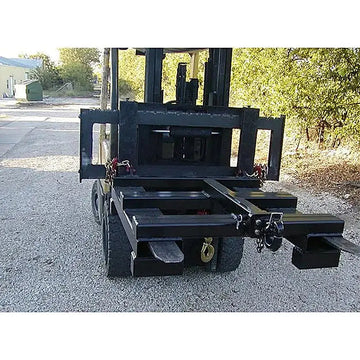
Forklift towing attachments: what they do and where they fit
Towing with a forklift is a horizontal-force job, not a lifting job, and that is the first thing to get straight before you buy. A truck's capacity plate describes vertical load at a stated load center. Pulling a trailer, a dumpster or a wheeled bin loads the truck through the drawbar instead, and three separate limits apply: the traction available at the drive tires, the towing figure your truck's manufacturer publishes, and the rated pull of the attachment itself. Whichever is lowest governs the job. The Star Industries Lift-N-Tow makes the distinction concrete: it lists a maximum towing capacity of 10,000, 16,000 or 30,000 lbs depending on model (1390B, 1395B, 1396C) and a separate maximum lift capacity of 12,000 lbs on the swivel hook. Two numbers, two jobs, and neither one is permission for the other.
The four forklift attachments for towing and pulling in this collection
Two of these are true hitch attachments, one is a rough terrain manual locking hitch, and two are pallet pullers that drag loads rather than tow them. Here is what our product data confirms:
| Attachment | Type / mount | Rated figures from our data | Price |
|---|
| Vestil Forklift Hitch (FTTM) | Fork-mounted hitch, 1 model (FTTM-2) | Made in USA, 1-year limited warranty | $354.33 |
| Vestil Rough Terrain EPT Manual Locking Hitch | Manual locking hitch attachment | See product page | See product page |
| Vestil Pallet Pullers (PAL) | Cam-action (PAL-14) and low-profile double scissor (PAL-LP) | 5,000 lb; PAL-14 has a 3 in jaw; 1-year limited warranty | $103.21 - $104.26 |
| Star Industries Lift-N-Tow | Universal slip-on fork style | Towing 10,000 / 16,000 / 30,000 lbs by model; 12,000 lbs swivel hook lift; 505 lbs without hitch adapter | See product page |
The Vestil Forklift Hitch ships as a single model, FTTM-2, made in the USA by Vestil Manufacturing. The two Vestil Pallet Pullers are a different tool entirely: they grip a pallet and drag it onto or off the forks, which is how you reach a pallet at the nose of a trailer. They are not towing devices, and the 5,000 lb figure is the puller's rating, not a towing rating.
Matching a towing forklift to your yard
Traction, not muscle, is usually what stops a towing forklift. A cushion-tire truck on smooth sealed concrete will spin before it reaches its drawbar limit, while a pneumatic-tire or rough terrain truck on packed gravel holds better. Grade matters for the same reason: a ramp a loaded truck climbs easily becomes a problem with an unbraked trailer behind it. Most towed yard equipment has no brakes of its own, so the forklift does all the stopping - leave far more distance than you would with a load on the forks. Steering is the other surprise. A forklift steers from the rear axle, so it pivots tightly and reverses nothing like a pickup; give operators open space to practice before the first live pull. Finally, check travel distance and duty cycle with your truck's manufacturer. Electric trucks in particular were engineered around lift cycles rather than sustained yard tractoring, and a long pull draws current for far longer than a lift does.
What OSHA and ANSI require when you add an attachment
Attachments are regulated equipment, not accessories. OSHA 1910.178(a)(4) states that modifications and additions affecting capacity and safe operation shall not be performed without the manufacturer's prior written approval, and that capacity, operation and maintenance instruction plates must be changed accordingly. OSHA 1910.178(a)(5) requires that a truck fitted with front-end attachments be marked to identify the attachments and show the approximate weight of the truck and attachment combination. OSHA 1910.178(l) sets the training and evaluation requirements for powered industrial truck operators, including truck-specific and workplace-specific instruction. OSHA 1910.178(q)(7) requires that trucks be examined at least daily, or after each shift where they are used around the clock. ANSI/ITSDF B56.1, the safety standard for low lift and high lift powered industrial trucks, treats stability and attachment use in more detail than the OSHA text does. If your application involves lifting from a hook rather than towing, ASME B30.20 covers below-the-hook lifting devices and ASME B30.10 covers hooks.
Fifth wheel attachments, wheel lifts and rear tow pins
Three related searches come up constantly and they describe three different tools. A forklift fifth wheel attachment mounts a kingpin coupler to the carriage so a lift truck can shunt semi-trailers across a yard; it is a substitute for a terminal tractor, not a hitch. A wheel lift for a forklift cradles a vehicle's tires so a disabled unit can be moved without any coupling point. A forklift rear tow pin is the pin at the counterweight; truck manufacturers generally provide it for recovering a dead truck, and their manuals commonly rule out using it to pull working loads, so read yours before hooking anything to it. This collection covers the middle ground instead: fork-mounted hitch attachments and pallet pullers that need no drilling and no wiring, and that come off in minutes when you want the forks back.
How to buy a forklift hitch that actually fits
Measure your forks first. Slip-on attachments are sized to the fork blade, and the Star Industries Lift-N-Tow lists fork pockets of 48" L x 8¾" W x 3" ID and fits forks up to 8" W x 2¾" thick - check those figures with a tape measure on your own truck rather than against a spec sheet from whoever sold it. Then confirm the retention method: every fork-mounted attachment needs a positive lock or safety chain so it cannot slide off during a pull. Check the product page for what coupling hardware is included, since a tow ball, pintle or hitch adapter may be ordered separately; the Lift-N-Tow's 505 lb weight, for instance, is published without a hitch adapter, and that weight sits on the carriage and eats into net capacity. In service, inspect welds and pins for cracks, keep locking mechanisms and swivels greased, and take the attachment out of service if anything is bent or deformed. The Vestil Forklift Hitch (FTTM) and Vestil Pallet Pullers carry a 1-year limited warranty and are made in the USA by Vestil Manufacturing.