Telehandler Lifting Attachments: What a Lift Hook Actually Changes
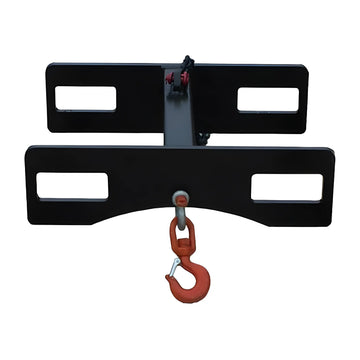
A telehandler lifting hook attachment converts the fork tines into a single suspension point. The hardware is simple — a welded steel body with fork pockets that slides over the tines and is held in place with retaining hardware — but the change in how the load behaves is not. A load resting on forks is stable and its center of gravity is fixed relative to the carriage. A load hanging from a hook can swing, rotate and pendulum as the boom extends, as the frame settles on soft ground, or as the operator brakes. That dynamic behavior, not the static rating stamped on the attachment, is what usually determines whether a lift goes well.
It is also why hooks are treated differently in the rules. OSHA's construction crane standard, 29 CFR 1926.1400, excludes powered industrial trucks from coverage except when they are configured to hoist and lower by means of a winch or hook and horizontally move a suspended load. Bolting a hook onto your forks can therefore move that particular task from forklift rules into crane rules on a construction site. Plan for that before the attachment shows up on the job.
Telehandler Lifting Hook Attachments in This Collection
All three products here are Star Industries fork-mounted attachments. Two are lifting attachments; the third is a carrier for a hydraulic hammer, listed here because it mounts the same way. These are the verified specifications from our product data:
| Model | Attachment | Rated capacity | Weight | Mounting |
|---|
| 1366 | Forklift Lift Hook | 6,000 lbs (model 1366); 6,000–22,000 lbs across the model range | 105 lbs | Fork pocket 6¾" x 3" ID; 20" center-to-center fork opening; overall 29"W x 9¾"H x 24¼"L |
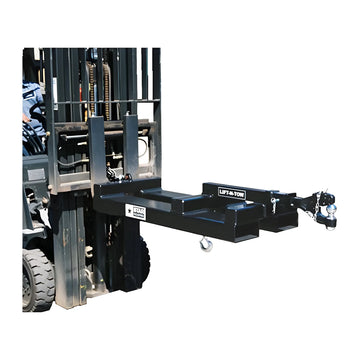
| 1390B | Lift-N-Tow | 4,000 lbs on the swivel hook; 2,000 lbs on the receiver jib; 10,000 lbs max gross towing weight | 220 lbs without hitch adaptor | Fork acceptance 6" wide x 2¾" thick; ball, pintle and combination hitches |
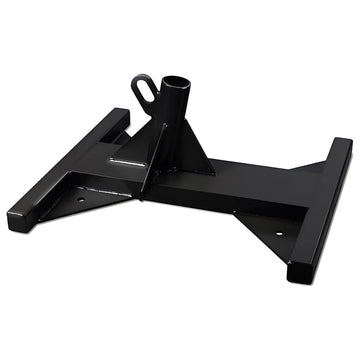
| 915 & 916 | Hydraulic Hammer Stand | Single hammer stand; accepts up to a 3.5" diameter moil point (model 915) | 175 lbs empty (model 915) | Adjustable mounting brackets, reinforced base supports; powder-coated high-strength steel |
Capacity: Read the Machine's Load Chart, Not Just the Hook
The attachment rating is a ceiling, not a permission. The governing number is whatever your telehandler's load chart allows at the boom angle, extension and load center you are actually working at — and that chart derates sharply as the boom reaches out. Two adjustments matter every time. First, the attachment's own weight comes off your available capacity: 105 lbs for the 1366 hook, 220 lbs for the 1390B. Second, the hook moves the load center further forward than a palletized load would sit.
The 1390B illustrates the leverage effect using our own catalog numbers rather than a hypothetical. The same attachment is rated 4,000 lbs on the swivel hook but 2,000 lbs on the receiver jib, because the jib carries the load further out from the carriage. Nothing about the steel changed — only the distance. Your machine's load chart behaves the same way, and the two derates stack.
Rigging, Standards and Suspended-Load Practice
The hook is one link in a chain of rated components, and the rest of that chain is governed by published standards. ASME B30.9 covers slings, ASME B30.10 covers hooks, and ASME B30.26 covers rigging hardware such as shackles and eye bolts. On construction sites, OSHA 29 CFR 1926.251 requires that slings and all fastenings and attachments be inspected each day before use and removed from service when damaged or defective. Chokers, shackles and softeners are not incidentals to buy later — size them when you size the hook.
Practical habits matter as much as paperwork. Use a tagline on anything with surface area, keep the load as low and as close to the machine as the work permits, and stop travel before the swing builds. Blind lifts need a signal person. Never let anyone ride the load or work beneath it.
Fit, Mounting and Site Conditions
Fork-mounted attachments fail to fit for boring reasons. Measure your tines before ordering: the 1366 has a 6¾" x 3" ID fork pocket with a 20" center-to-center opening, and the 1390B accepts a tine up to 6" wide by 2¾" thick. Wide-carriage machines with tines set beyond that spacing will not accept a fixed-spacing attachment without repositioning the tines. Confirm the retaining hardware engages properly and that the attachment cannot walk off the tines under a swinging load.
Site conditions decide the rest. Suspended loads amplify everything a rough-terrain machine does — grade, ruts, soft fill, potholes. Level the machine on its frame leveling or outriggers where equipped, plan the travel path before the load leaves the ground, and account for wind on large flat objects like panels and trusses.
Training, Modifications and the Data Plate
OSHA 29 CFR 1910.178(l) requires that operators of powered industrial trucks be trained and evaluated before operating, and attachment use is an operating condition that training should cover. Two subsections are directly relevant to buying an attachment. 1910.178(a)(4) states that modifications and additions affecting capacity and safe operation must not be performed without the manufacturer's prior written approval, with capacity, operation and maintenance instructions changed accordingly. 1910.178(a)(5) requires that a truck equipped with front-end attachments be marked to identify the attachments and show the approximate weight of the truck-and-attachment combination at maximum elevation with the load laterally centered.
For rough terrain variable-reach machines, ANSI/ITSDF B56.6 is the applicable consensus safety standard and is worth reading alongside the machine manual. Check with your telehandler's manufacturer that hook use is approved for your model and carriage, and update the capacity plate before the attachment goes into service.