What this concrete equipment collection covers
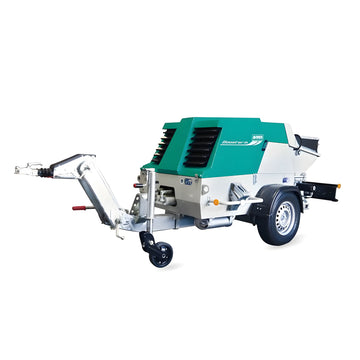
Vovlift's concrete equipment category is seven IMER products, all listed with Italy as country of origin, running from $1,795 to $137,749. Three groups sit inside that span. Rotor/stator pumps — the IMER Prestige 300 with a 24 HP Yanmar diesel — move plaster, grout, and mortar. Piston pumps with an S-valve — the IMER Booster 20 at 28 HP diesel and the IMER 1106427 Booster with hydraulic control, also 28 HP — handle concrete with coarser stone. Crawler placement booms — the Gerris 800 in gas and lithium versions — carry the discharge line out over the pour instead of crews dragging hose by hand. Two rotor/stator pumping kits, the 2L6 (1107088) and the IM25L (1107149), keep those pumps in service and let one machine change duty.
Rotor/stator or piston: match the pump to the material
The most common buying mistake in this category is shopping by horsepower instead of by material. A rotor/stator pump meters a steady, low-pulsation stream and suits fine, flowable mixes. The 2L6 kit lists its materials as binders, mortars, plaster, and fiber-reinforced mortars, with a maximum grain size of 6 mm (0.25 in.) and a rated pressure of 435 PSI (30 bar) — that grain figure is the hard limit, and feeding coarser stone through a stator is what destroys it. Piston pumps with an S-valve work the other end of the range: they build pressure in discrete strokes and tolerate concrete with larger aggregate, which is why the Booster 20 and the 1106427 Booster are the machines to price out for slabs, footings, and walls rather than for stucco, grout, or self-leveling underlayment. If a pumped mix is being specified for a job, ACI 304.2R, Guide to Placing Concrete by Pumping Methods, is the reference the mix designer and the pump supplier should both be working from.
Placement booms, reach, and site access
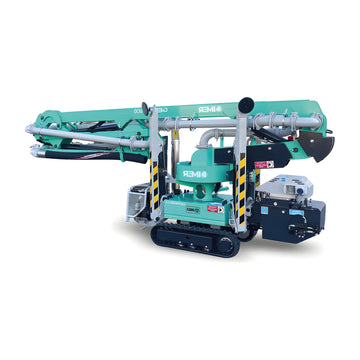
A placing boom solves distance and elevation; it does not replace the pump feeding it. The Gerris 800 Gas (1128758) lists a maximum height/reach of 36 ft 9 in., a casting depth of 16 ft 5 in., a maximum aggregate size of 1 in., and a stabilizer capacity of 1930 daN. Its transport dimensions are 2 ft 7 in. wide by 16 ft 1 in. by 6 ft 6 in., and that 2 ft 7 in. width is the number worth checking first — it decides whether the machine reaches an interior pour through a standard opening or has to be craned in. Power on the gas unit is a gasoline engine plus a 240V electric motor, so it can tram on the engine and run on shore power where exhaust is unwelcome. The Gerris 800 Lithium is the battery version, listed at 5,512 lb and 32 x 193 x 80 in. Whichever you pick, deck loading is a structural question: confirm with the engineer of record that the slab, shoring, or formwork carries the machine's weight plus the concrete being placed.
Rotor and stator life, and what these kits actually fit
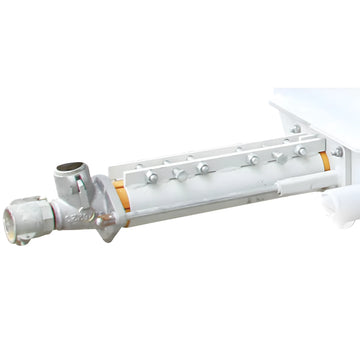
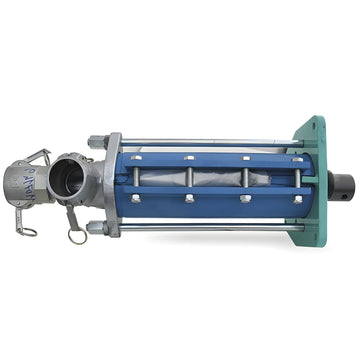
If you arrived searching for max-life concrete pump truck rotor parts, read this first: the 1107088 (2L6) and 1107149 (IM25L) kits listed here are rotor/stator sets for IMER Step-Up 120 and 120 A spray and grout pumps and the IMER Prestige — not wear parts for truck-mounted boom pumps. The 1107149 kit is a helical blade and rotor/stator changeover kit and ships with mounting hardware and transition assemblies. On any rotor/stator pump, the stator is the consumable and its life is driven by operating discipline more than by brand: running dry even briefly, over-tightening the stator clamp to chase pressure, pumping against a restricted or blocked line, abrasive sand in the mix, and skipping a full water flush at the end of the pour. Buyers who stock a spare kit alongside the machine avoid the situation where a $1,795 wear part idles a crew for a day.
Training, standards, and safe pumping practice
Concrete pumping is a pressurized-line operation and should be planned as one. OSHA 1926.702 addresses requirements for concrete placement equipment, including concrete pumping systems, hose section securement, and connectors on compressed-air hoses used for line cleanout. ASME B30.27, Material Placement Systems, is the consensus standard covering placing booms and related concrete placement equipment, including inspection and operation. OSHA's respirable crystalline silica standard for construction, 1926.1153, applies to tasks that generate silica dust, which includes handling and mixing dry bagged binders and mortars feeding these pumps. Beyond the written standards: nobody reaches into a running hopper, blocked lines get relieved by trained personnel rather than by cranking pressure, and the discharge end is controlled at all times.
Freight, unloading, and cost past the purchase price
The machines here are freight-class 92.5 and heavy enough to need a plan at the dock. The Prestige 300 is listed at 1,653 lb, the Booster 20 at 3,100 lb, and the Gerris 800 Lithium at 5,512 lb, so budget for a forklift, telehandler, or crane at delivery rather than a liftgate. Ongoing cost is mostly consumables and fuel: rotor/stator kits, delivery hose, couplings and gaskets, cleanout sponges and equipment, plus diesel or gasoline for the engine-driven units. The lithium Gerris trades fuel and exhaust for charging time and battery care, which usually pays off on interior, occupied, or noise-restricted sites and matters less on open ground. Compare a diesel and a battery machine on the whole picture — fuel, ventilation requirements, downtime for charging, and where the work actually happens — not on the sticker alone.