What a manual pallet stacker does — and where it fits
A manual pallet stacker is a walk-behind lift truck: the operator pushes it into position, raises the load on forks or a platform, and sets it down on a rack beam, a machine table, a workbench or another pallet. Buyers often search for a manual forklift when they mean this machine, and the comparison is fair — it does forklift work at walking pace. What it gives up is travel speed and distance; what it gives back is a far lower purchase price, a smaller turning envelope, and on hand-pumped models no battery or charger to manage at all.
Manual stackers suit low-cycle work: replenishment in a retail back room, staging parts at a work cell, loading a mixer or press, drum handling in a chemical room, or acting as the second machine in a warehouse that already runs a rider truck. If pallets move continuously for a full shift, a manual stacker becomes the bottleneck and the operator feels it. Count lifts per shift before you look at anything else.
Manual, semi-electric and high lift pallet trucks
Three configurations cover most of what buyers weigh against each other, and this collection carries all three.
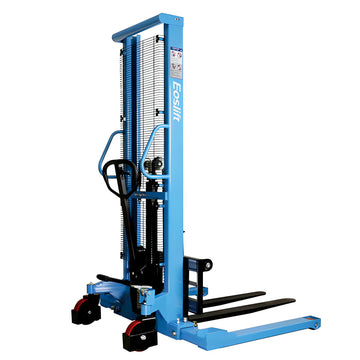
- Hand-pumped manual stackers raise the load with a hydraulic hand or foot pump and are pushed by the operator. Nothing to charge, fewest parts to fail. The Vestil Portable Mini Stacker (HWL-260) sits at the light end at 260 lb capacity and $888.74; the EOSLift H10J is the workhorse at 2,200 lb with 63 in of lift.
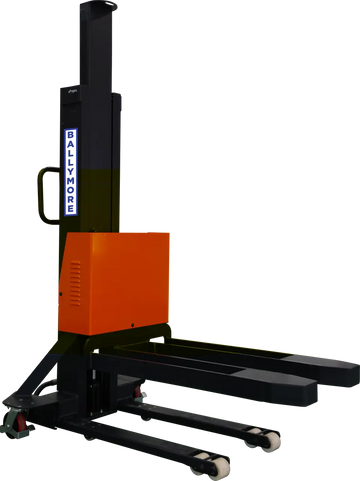
- Semi-electric stackers keep manual push/pull travel but power the lift, which matters when one operator makes repeated lifts. The Ballymore BALLYPALSLS-54 is a fork-over semi-electric: electric motor with hydraulic pump, rechargeable battery, manual propulsion, 1,100 lb capacity, 54 in lift on 43 in forks.
- High lift pallet trucks use the fork carriage itself as the lifting platform, so a pallet can be raised to a comfortable working height rather than only stacked. We carry two Vestil High Lift Trucks (Pramac) models, PMC-HIPM-21-DC and PMC-HIPM-27-DC, from $4,964.88 to $5,625.38.
Fork geometry is a separate decision. Fork-over and straddle-leg units run support legs under or around the pallet and need bottom clearance to do it. Counterbalanced machines — our Vestil DRLT drum stackers, for instance — carry the weight behind the load instead, so they can place a drum onto a scale, mixer or containment pallet where legs would not fit. Counterbalancing costs capacity and adds weight for the same footprint. That is the trade.
Sizing a manual pallet stacker: capacity, lift height and forks
Capacity is rated at a stated load center. The EOSLift H10J is rated 2,200 lb at a 23.6 in load center. A load whose center of gravity sits farther out on the forks derates the truck, so a long or unevenly packed load can exceed the rating well before the scale ticket says it should. Weigh a real load rather than estimating it.
Lift height is measured to the fork face, not to the top of your load. Add pallet and load height to find the shelf you can genuinely reach. Check lowered mast height against your door headers, trailer openings and sprinkler lines too — the H10J stands 81.1 in with the mast lowered.
Fork length and width have to match your pallet. The Grocery Manufacturers Association (GMA) pallet, the most common footprint in North American distribution, measures 48 by 40 in, and forks shorter than the pallet leave the far edge unsupported. The H10J uses 42.1 in forks with overall width adjustable from 8.3 to 32.7 in; the Ballymore uses 43 in forks. If you handle drums, closed-bottom containers, slip sheets or custom skids, a platform or drum-specific machine is a better answer than forks.
Site conditions that make or break a manual stacker
Push effort is what buyers underestimate. These machines are heavy before they pick anything up — the H10J alone has a 759 lb service weight — and one person has to move that mass. Smooth, level, sealed concrete is what they are designed for. Expansion joints, floor drains, worn asphalt, dock plates and even a mild ramp turn an easy push into a two-person job or an unsafe one. Gravel, grass and rutted yards are outside the category entirely.
Confirm trailer floors and dock levelers are rated for the machine plus its load before assuming a stacker can go inside. Environment matters as well: refrigerated rooms, food plants and daily-sanitation areas are where a stainless machine such as the Vestil ULM-MS-220 Stainless Steel Manual Load Stacker earns its price, because painted steel corrodes quickly under wash-down chemicals.
Training, standards and safe stacking
OSHA 1910.178 governs powered industrial trucks and requires documented operator training, evaluation and refresher training under 1910.178(l). A hand-propelled, hand-pumped stacker is not a powered industrial truck under that definition, so the formal certification requirement generally does not attach — but the training is still the cheapest safety spend you will make, and if you buy semi-electric equipment, confirm scope with your safety officer instead of assuming. ANSI/ITSDF B56.10 is the standard covering manually propelled high lift industrial trucks, and ANSI/ITSDF B56.1 covers low lift and high lift powered industrial trucks; both set out user and operator responsibilities worth reading before writing a site procedure.
For the stack itself, OSHA 1910.176 requires stored material to be stacked, blocked, interlocked and limited in height so it is stable and secure against sliding or collapse, and requires aisles and passageways to be kept clear. In practice that means heaviest cartons on the bottom, the load square to the pallet with nothing overhanging the deck boards, banding or wrap applied before lifting, forks kept low while traveling, and the load raised only once the machine is squared up to the rack.
What Vovlift carries in manual pallet stackers
Six models, three brands, $889 to $13,679. The Vestil units are made in the USA by Vestil Manufacturing and carry a 1-year limited warranty.
| Product | Brand | Rated capacity | Max lift height | Notes |
|---|
| EOSLift H10J Manual Stacker | EOSLift | 2,200 lb | 63 in | 23.6 in load center, 42.1 in forks, 8.3–32.7 in fork width, 759 lb service weight |
| Ballymore BALLYPALSLS-54 | Ballymore | 1,100 lb | 54 in | Fork-over semi-electric; battery-powered hydraulic lift, manual push/pull, 43 in forks |
| Vestil Portable Mini Stacker (HWL-260) | Vestil | 260 lb | — | $888.74 |
| Vestil Stainless Steel Manual Load Stacker (ULM-MS-220) | Vestil | 220 lb | — | $13,679.28; stainless construction for wash-down duty |
| Vestil High Lift Trucks (Pramac) | Vestil | — | — | Two models, PMC-HIPM-21-DC and PMC-HIPM-27-DC, $4,964.88–$5,625.38 |
| Vestil Counter Balanced Drum Stackers (DRLT) | Vestil | — | — | Three models, $3,692.61–$7,179.34; manual and 12V lift versions |
A dash means that figure is not published in our spec table for that model — the product page carries the full detail per configuration. Budget past the sticker as well: hydraulic pumps eventually need seals, mast chains and rollers need lubrication and inspection, and load wheels are a wear item on rough floors. Semi-electric units add battery care, and a battery that never gets a full charge is a common reason a good stacker gets retired early.