Telehandler concrete dispensers: what a side-chute hopper actually does
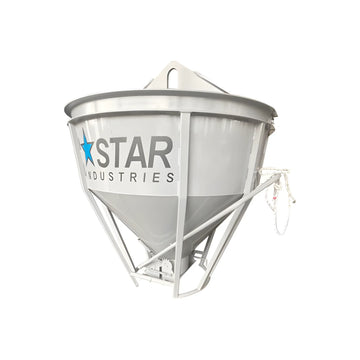
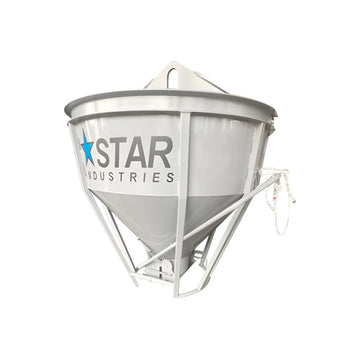
A concrete dispenser is a steel hopper your machine carries to the placement point and empties through a gate. It covers the ground between a truck-chute pour and a full pump setup: footings on the far side of a structure, piers and column forms, grade beams behind an open trench, deck patches, and repair work where mobilizing a pump truck is not justified. All three units in this collection use a side chute, so concrete is placed beside the machine instead of directly under the hopper. That matters for form work, where the operator needs to see the target and keep crew members out from under a suspended load.
Compare the three Star Industries concrete hoppers
| Model | Capacity (cu yd) | Capacity (lb) | Height | Width | Notes from product data |
|---|
| 1510 | 1.05 | 4,586 | 44 in | 49 in | Fork pockets offered as the 1510FP; compatible with cranes, excavators and forklifts |
| 1520 | 1.31 | 5,732 | 51 in | 49 in | Heavy duty steel meeting ASME safety standards; lever-operated discharge gate with spring system; detachable side chute with center discharge; fork pockets offered as an option |
| 1530 | 1.96 | 8,598 | 71 in | 49 in | ASME compliant; side chute; fork pockets not available — Star supplies fork pockets only for the 1510 and 1520 |
The pattern is straightforward: one width across the range, rising height and rated load as volume goes up. The 49 in width is the number to check against gate openings, form spacing and the clear path to the pour. The height spread — 44 in to 71 in — is the number to check against your working headroom.
How to size a concrete dispenser for your machine
Size against three limits, not one. First, the hopper's own rated capacity in pounds, listed above for each model. Second, your machine's capacity at the reach and boom angle you will actually work at, read off its load chart — a telehandler's rated capacity falls off sharply as the boom extends and the load moves away from the front axle, so the machine's headline rating is the wrong figure to size against. Third, the combined weight of the concrete plus the attachment's own tare weight; ask us to confirm tare for the model you are considering before you match it to a chart.
Volume should be matched to the pour, not maximized. A larger hopper means fewer trips but a heavier suspended load at reach and a longer fill cycle at the truck. If your pours are column forms or small footings taken in stages, the 1510 or 1520 gives finer control and lighter loads; if you are feeding a continuous placement and the machine has the capacity at reach, the 1.96 cu yd 1530 cuts trip count. Get the unit weight of your specific mix from your ready-mix supplier — lightweight, normal-weight and heavily aggregated mixes do not weigh the same per cubic yard, and the pound rating is the limit that governs.
Mounting: fork pockets, crane hook and excavator work
Mounting method decides which model you can buy. Star's product data lists fork pockets for the 1510 (as the 1510FP) and as an option on the 1520, and explicitly states they are not available for the 1530. If your plan is to carry the hopper on forks, that rules the 1530 out. All three list compatibility with cranes, forklifts and excavators, so the 1530 is a suspended-load unit in practice. Confirm the specific mounting interface for your machine with us before ordering rather than assuming a pocket or hook will fit.
Where a hopper is lifted below the hook rather than carried on forks, it is being used as a lifting device: ASME B30.20 covers below-the-hook lifting devices and ASME BTH-1 addresses their design classification and marking. The 1520 and 1530 listings both note ASME-compliant construction. Keep the identification markings legible — they are what an inspector looks for.
Safety rules that apply to concrete buckets
Two sets of rules apply on most jobs. For placement itself, OSHA 1926.701(e) requires that employees be kept out from under concrete buckets while the buckets are being elevated or lowered into position, that buckets be routed so no employee is unnecessarily exposed, and that no employee ride a concrete bucket. The side chute helps here: the crew works to the side of the load rather than beneath it.
For the carrier, OSHA 1910.178 requires training, evaluation and refresher training for operators of powered industrial trucks and requires that attachments be considered in the truck's capacity, while ANSI/ITSDF B56.6 is the standard covering rough terrain variable reach trucks. Whenever you add an attachment, the operative rule is that the machine must be rated for that attachment and that load, at that reach.
Cleanout, maintenance and what buyers get wrong
Concrete equipment fails from neglect, not from work. Wash the hopper and chute out at the end of every pour and before any break long enough for the mix to stiffen — cured buildup on the gate seat is what stops a discharge gate from closing cleanly. The 1520's lever-operated gate uses a spring system; check that the spring returns fully and the lever moves freely before each pour, and keep the pivot points clean. On a detachable chute, verify the retention hardware is in place and tight every time it goes back on. Inspect welds, lifting points and fork pockets for cracks, deformation and wear before use.
The most common buying mistakes on this page: sizing by cubic yards alone and blowing past the pound rating with a heavy mix; buying the 1530 expecting to run it on forks; ignoring the 71 in height until the hopper will not fit under a deck or through an opening; and forgetting that the machine's capacity at full reach — not its maximum rating — is the real ceiling. Plan washout in advance as well: the EPA's Construction General Permit requires that concrete washout be contained rather than discharged, so a washout station belongs in the plan alongside the attachment.