What AC Recovery Machines Do in a Service Bay
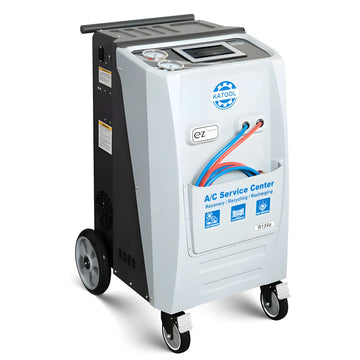
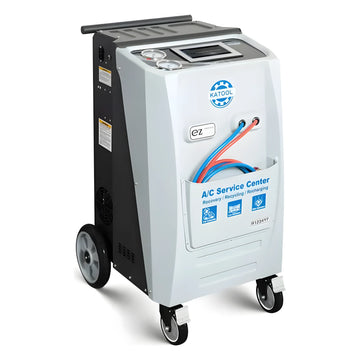
An automotive A/C recovery machine automates a four-step cycle that used to be done with separate gauges, pumps and cans: recover the existing refrigerant charge out of the vehicle, recycle it by filtering oil and moisture, evacuate the system under deep vacuum to boil off remaining moisture, then recharge a measured amount of refrigerant and oil back in. Both Katool A/C units in this collection are described as fully automatic recovery, recycle and recharge machines, meaning the cycle runs from the control panel rather than requiring the technician to stand over manual valves.
The regulatory driver matters here. EPA Section 609 of the Clean Air Act requires anyone who repairs or services motor vehicle air conditioning for compensation to be certified and to use approved refrigerant handling equipment. Venting refrigerant to the atmosphere during service is prohibited, which is why recovery capability — not just recharging — defines this equipment category.
R-134a or R-1234yf: Picking the Right Automotive A/C Machine
This is the first and most consequential decision, and it is not a preference. A machine is built and plumbed for one refrigerant. The Katool KT-AC1800 is an R-134A dual A/C machine; the Katool KT-AC2100 is built for R-1234YF. Service fittings differ between the two refrigerants specifically to prevent cross-charging, and mixing refrigerants contaminates both the vehicle system and the machine's internal storage tank, which then has to be recovered and disposed of rather than reused.
Which one you need follows the vehicles in your bays. R-134a covers a large existing US fleet; R-1234yf is what newer vehicles use, and it is classified A2L — mildly flammable — under ASHRAE Standard 34, which is why R-1234yf equipment is engineered differently from R-134a equipment. SAE J2788 is the performance standard for R-134a recovery, recycling and recharging equipment used on motor vehicles, and SAE J2843 is the corresponding standard for R-1234yf equipment. A shop that services both fleets generally ends up owning one machine of each type rather than trying to make a single unit cover both.
Specs That Matter When Comparing AC Recharge Machines
The two Katool A/C machines share a common platform, so the comparison is mostly about refrigerant type. Below are the specifications as published in our product data:
| Specification | KT-AC1800 (R-134A) | KT-AC2100 (R-1234YF) |
|---|
| Dimensions (W x H x D) | 550 mm x 1100 mm x 750 mm (21.7 in. x 43.3 in. x 29.5 in.) | 550 mm x 1100 mm x 750 mm (21.7 in. x 43.3 in. x 29.5 in.) |
| Weight | Not listed | 120 kg (264.6 lbs) |
| Tank capacity | 14.6 kg (30 lbs) | 14.6 kg (30 lbs) |
| Filter drier ability | 80 kg (176 lbs) | 80 kg |
| Vacuum pump | 120 L/min, 2 stage | 120 L/min, 2 stage |
| Compressor | 1/2 HP | 1/2 HP |
| Scale resolution | 3 g | 3 g |
| HP/LP gauges | 80 mm (3.15 in.) | 80 mm |
| Tank gauge | 40 mm (1.57 in.) | 40 mm |
| Service hose length | 3 m (9.8 ft) | 3 m (9.8 ft) |
| Power supply | 220 V - 50 Hz | 220 V - 50 Hz |
Two of those lines deserve comment. Scale resolution is the smallest increment the internal scale can read — it is a measure of display granularity, not a warranty of total charge accuracy, which also depends on hose clearing and calibration. Filter drier ability is a service-life figure: it tells you how much refrigerant the drier is rated to process before replacement, which is what drives your consumables budget more than any other single number.
Shop Power, Footprint and Hose Reach
Check the electrical supply before you order. The published power supply for both Katool A/C machines is 220 V - 50 Hz. US shop power is 60 Hz, so confirm compatibility and the correct configuration for your building with us before purchase rather than after delivery — this is the most common avoidable problem when buying imported service equipment.
Footprint is modest at 21.7 in. wide and 29.5 in. deep, but the KT-AC2100 is listed at 264.6 lbs, so plan for a machine that rolls between bays on a smooth floor rather than one a technician repositions by hand across broken concrete or up a ramp. The 3 m (9.8 ft) service hoses set your working radius: the machine has to park close enough to the vehicle's high and low side ports that hoses are not stretched taut across a walkway. In a tight bay, measure from where the cart can actually stand to the service ports on the vehicles you work on most.
Maintenance and Operator Requirements
Recovery machines are consumable-driven equipment. The filter drier is replaced on a duty basis once its rated throughput is reached, the two-stage vacuum pump needs its oil changed on a schedule because moisture pulled from vehicle systems ends up in it, and the internal scale should be checked against a known reference periodically since every charge is only as good as the weight it reports. Machines that sit unused still lose accuracy, so a low-volume shop should not assume calendar time is free.
On the operator side, EPA Section 609 certification is the requirement for paid MVAC service, and technicians handling R-1234yf should understand its A2L flammability classification under ASHRAE Standard 34 before working around ignition sources. Keep recovered refrigerant identified by type — an unlabeled cylinder is a contamination event waiting to happen.
Related Shop Fluid Service Equipment
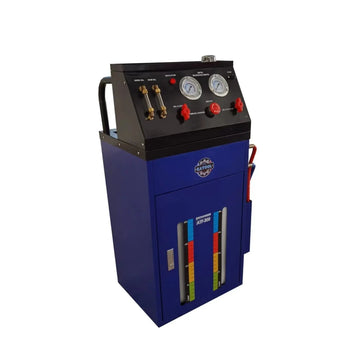
This collection also includes the Katool ATF 12V Automatic Transmission Fluid Exchange & Flush Machine (SKU KT-ATF), which is workshop equipment rather than an A/C machine. It runs on 12V power and performs automatic transmission fluid exchange, flush and cleaning. Shops often buy it alongside A/C service equipment for the same reason — both replace a slow, messy manual procedure with a metered machine cycle that a technician can set up and leave running while working elsewhere. If you are outfitting a general service bay rather than an A/C-only station, it is worth comparing on the same visit.