What a Skid Steer Brush Cutter Does
A skid steer brush cutter is a hydraulically driven rotary cutter that mounts to the front of a loader and takes down standing brush, saplings, briar and heavy grass in a single pass. It is not a finish mower and it is not a forestry drum mulcher. A finish mower is built for maintained turf and will not survive woody stems. A drum mulcher grinds standing wood into chips with carbide teeth, costs several times more, and generally demands a high-flow machine. A brush cutter sits between the two: heavy blades sever stems near ground level, and the deck chops the downed material as the loader drives over it. Typical work is fence lines, ditch banks, utility and pipeline right-of-way, hunting lanes, pasture reclamation and lot cleanup ahead of grading. Be honest about duty cycle before you shop. A contractor running right-of-way keeps the cutter loaded for hours at a time; a landowner opening trails a few weekends a year is buying for occasional, lighter work, and the two buyers do not need the same machine.
Open-Front vs Closed-Front Skid Steer Brush Cutters
The front of the deck is the biggest functional difference between the two Loflin Fabrication cutters we stock, and it is the decision most buyers get wrong.
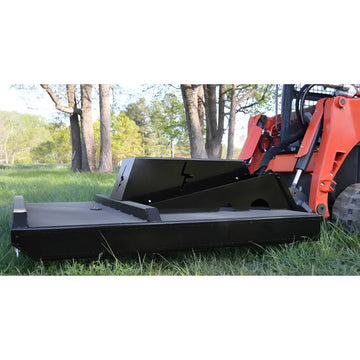
- Open-front — the leading edge is open so standing stems feed under the deck and reach the blades before the deck pushes them over. This is the layout operators generally prefer for larger woody material and for pushing into thick standing brush.
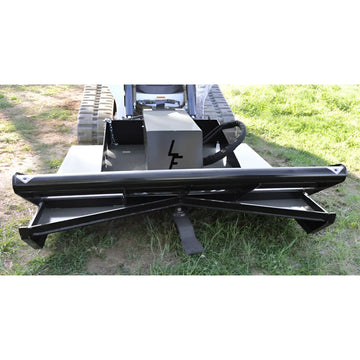
- Closed-front — the front is enclosed. Our Loflin closed-front cutter directs debris back into the cutting chamber so it leaves a mulched pile rather than long, whole stems lying across the ground. That matters when someone has to walk, mow or drive the site afterward.
The trade-off is cleanup versus feeding. A closed front recuts material and keeps more of it under the deck; an open front takes bigger stems more readily but throws more debris out the front, so bystander control and cab glazing matter more. If the cut area will be maintained afterward, the closed front usually saves a second pass. If you are opening ground for the first time, the open front is the more forgiving tool.
Matching the Cutter to Your Loader's Hydraulics
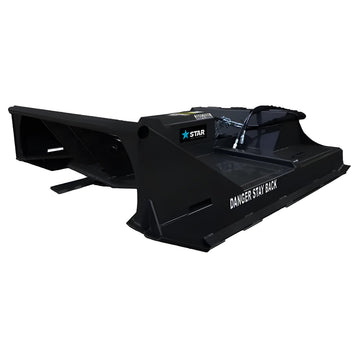
Hydraulic flow, not horsepower, decides whether a brush cutter performs. The Star Industries 195-72 lists a required hydraulic flow rate of 16-26 GPM, which is squarely in standard-flow territory for full-size skid steers — check your machine's published auxiliary flow against that range before ordering. The Loflin Fabrication open-front cutter uses a geroller-style motor with variable displacement depending on flow, so it adapts to what the loader delivers rather than demanding one fixed number.
Three practical points. First, an undersupplied cutter does not break, it simply bogs down and stalls in heavy material, which is the most common complaint from buyers who never checked flow. Second, confirm your auxiliary couplers and whether the attachment needs a case drain line — mismatched couplers are a same-day problem you can solve before delivery. Third, attachment weight comes straight out of your rated operating capacity: the Star 195-72 has a net weight of 994 lbs, and a light machine carrying that out front handles very differently on slopes and soft ground.
Blades, Decks and Drive Systems
All three cutters we carry use bi-directional blades, meaning both edges cut and the blade can be reversed rather than replaced when one edge dulls. The Star 195-72 runs three bi-directional AR400 steel blades driven by a high-torque Parker hydraulic motor through a heavy-duty 100-hp gearbox. Both Loflin cutters use heat-treated forged steel blades on a direct-drive power system — the open-front model with a proprietary direct drive and a one-piece heat-treated forged-steel axle, the closed-front with replaceable blades and a powder-coated finish.
Deck steel is where corners get cut in this category. Both Loflin cutters specify a 1/4-inch reinforced steel deck. Ask about deck thickness, blade material and whether blades are field-replaceable on anything you compare, because those three items drive most of the long-term cost. Budget for blade replacement as a consumable, and expect to inspect blades, bolts and the mounting frame after every rocky job — impact damage to a spinning blade is not something to discover on the next start-up.
Site, Safety and Operator Considerations
Walk the area before you cut. Rocks, buried concrete, old fence wire, T-posts and stumps are what destroy blades and gearboxes, and they are far cheaper to flag than to hit. Wire wrapping a shaft is a recurring failure mode on old fence lines. Cut in stages on heavy material rather than trying to take everything in one pass, and keep the deck high enough to clear obstacles you cannot see.
OSHA's construction standard at 29 CFR 1926.602 covers material handling equipment, including requirements for inspecting equipment before use, and OSHA 29 CFR 1926.1000 sets rollover protective structure requirements for several classes of construction earthmoving equipment — confirm the ROPS and falling-object protection rating on your specific loader before working in standing timber or on slopes. Beyond the regulations: keep bystanders well clear of the discharge path, verify cab glazing and door screens are in place, and never leave a cutter spinning while dismounting.
Comparing the Three Skid Steer Brush Cutters We Carry
| Model | Cutting width | Blades | Front / drive |
|---|
| Loflin Fabrication Open-Front | 60-inch and 72-inch | One-piece heat-treated forged steel, bi-directional | Open front; proprietary direct drive, geroller motor |
| Loflin Fabrication Closed-Front | Not published | Heat-treated forged steel, replaceable, bi-directional | Closed front; direct drive, mulches debris |
| Star Industries 195-72 | 72-inch | 3 bi-directional AR400 steel blades | Parker motor, 100-hp gearbox; 16-26 GPM; 994 lbs |
All three use a universal skid-steer quick attach mount, so they swap between full-size machines with that plate. Prices in this collection run from $6,394 to $9,509. If you want mulched cleanup, start with the closed-front Loflin. If you want to push into heavy standing brush, start with the open-front. If you want published flow and weight figures to match against your loader's spec sheet, the Star 195-72 is the most fully documented option here.