What a telescopic lift is, and what buyers mean by the term
A telescopic lift extends a work platform on a boom built from nested sections that slide out along a single straight line. The same machine gets searched for as a telescoping lift, a telescopic lifter, a straight boom or a stick boom, and in aerial-platform language it is a boom-type mobile elevating work platform, or MEWP. The defining trait is geometry rather than size: because the boom extends in a line instead of folding at a knuckle, height and outreach build together along a predictable arc, and the operator places the basket with one continuous motion. That is why telescopic booms are the usual answer when the work face is open and the platform simply has to get out and up — glazing runs, steel, signage, tree work over a clear approach.
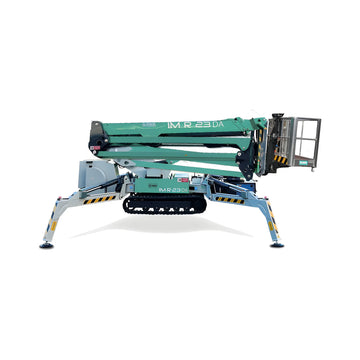
Two of the three machines here are listed as articulated and telescopic, which means an articulating riser is combined with a telescoping section. That pairing keeps the straight-line reach but adds the ability to lift, reach over an obstruction, and then come back down to the work — useful in atriums, over roof edges, and around plant equipment where a purely straight boom would have no path to the target.
Telescopic lifts we carry and their verified specifications
All three units are IMER machines. Every figure below comes from our product data for these specific models; nothing is generalized from the category.
| Model | Working height | Platform height | Platform capacity | Machine weight | Power |
|---|
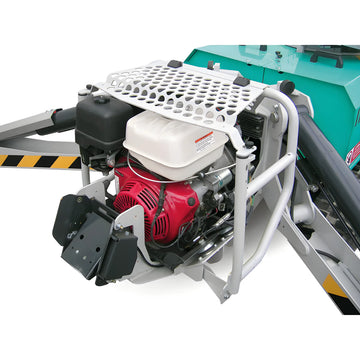
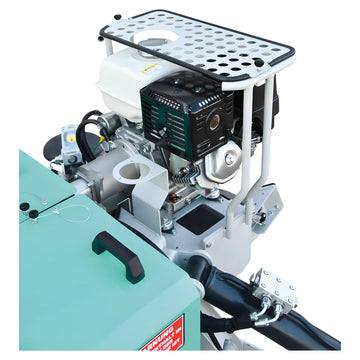
| IMER 1128728 (articulated & telescopic) | 42 ft (approx. 12.8 m) | 36 ft (approx. 11 m) | 510 lbs | 3,410 lbs | Honda GX390 gas + electric (bi-energy) |
| IMER 1128759 (telescopic) | 49 ft 6 in (13.1 m) | 43 ft | Approx. 507 lbs | 4,475 lbs | Not listed in our product data |
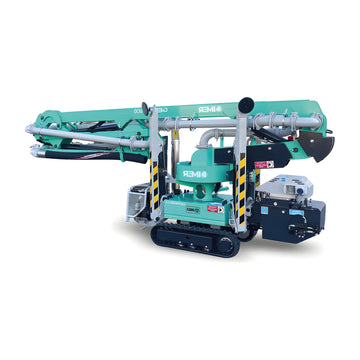
| IMER 1128632 (articulated & telescopic) | 75 ft (19 m) | 68 ft | 510 lbs | 6,525 lbs (gas) | Honda GX800 gas + electric motor (bi-energy) |
Other published details worth weighing: the 1128759 lists 23 ft of side outreach at 506 lbs, 124-degree hydraulic basket articulation, and an adjustable transport width of 2 ft 7 in to 3 ft 5 in. The 1128632 runs on rubber tracks. The 1128728 lists a transport length of 12 ft 4 in and 124-degree basket rotation. All three list 355-degree non-continuous turret rotation, so the operator repositions the turret in an arc rather than spinning through it continuously.
Telescopic, articulated or scissor: choosing by the obstacle, not the height
Height gets people to a shortlist; the obstacle between the machine and the work decides the machine. A straight telescopic boom is the most direct way to convert ground position into platform position, and it usually gives the best horizontal outreach for a given class of machine — the 23 ft side outreach figure on the 1128759 is the kind of number that matters when a fence, planting bed or piece of process equipment keeps the chassis away from the wall.
An articulated boom trades some of that straight reach for the ability to fold over an edge or under a structure. If the work is behind a parapet, above a mezzanine rail, or on the far side of a duct run, straight-line reach cannot get there and articulation can. Scissor lifts, by contrast, only go vertical and take the whole platform with them; they are the cheaper answer when the floor is flat, the work is directly overhead and a large platform matters more than reach. If your jobs mix all three situations, the combined articulated-and-telescopic machines in this collection cover more of them from one asset.
Site constraints: ground, access width and transport
Before capacity, check whether the machine can physically get to the work and stand on it. Access width governs the choice on interior and courtyard jobs — the 1128759 adjusts between 2 ft 7 in and 3 ft 5 in for transport, which is what lets a machine of that height class travel a corridor or gateway. Machine weight governs the other half: 3,410 lbs, 4,475 lbs and 6,525 lbs are very different propositions for a finished floor, a raised deck, a plaza slab over occupied space or soft ground on an outrigger footprint. Where a structural slab is involved, get the allowable loading from the building's engineer rather than assuming it.
Transport is the constraint people cost out last and regret first. Machine weight plus trailer determines what tow vehicle and license you need, and the 1128728 lists a transport length of 12 ft 4 in, which affects storage as much as hauling. Bi-energy power removes a different constraint: with an electric motor available, a gas-engine machine can work indoors or in noise-restricted hours without exhaust in the space, which is the main reason contractors pay for the dual setup.
Training, inspection and the standards that apply
These are regulated machines, and the rules are worth reading before purchase because they shape your operating cost. OSHA 1910.67 covers vehicle-mounted elevating and rotating work platforms, and OSHA 1926.453 covers aerial lifts in construction — including the requirement that an employee in a boom-type platform wear a body belt with a lanyard attached to the boom or basket. The ANSI/SAIA A92 suite governs MEWPs in the US: A92.20 addresses design, A92.22 addresses safe use — including a site risk assessment and a rescue plan before the platform is elevated — and A92.24 addresses operator and occupant training. Under A92.20, boom-type machines like these fall in Group B, where the platform can travel outside the tipping lines of the chassis.
Electrical clearance is the other rule to know: OSHA 1910.333 sets minimum approach distances for unqualified persons near energized lines, requiring 10 feet of clearance for voltages up to 50 kV, with greater distances above that. Plan boom paths around service drops accordingly, and remember that A92.22 puts responsibility for supervision and site conditions on the user, not just the operator.
What buyers most often get wrong
- Buying working height instead of platform height. Working height includes the operator's assumed reach; the platform height is where your feet actually stand. On the 1128632 that is 75 ft versus 68 ft.
- Ignoring capacity against two people plus tools. Platform capacity here is roughly 507–510 lbs, which is a real constraint once a second worker, a toolbag and materials are aboard.
- Assuming continuous rotation. These machines rotate 355 degrees non-continuously, so set-up position still matters.
- Costing the machine but not the program. Training, annual and pre-use inspections, fall-protection equipment, hauling and storage are recurring costs that often exceed the price gap between two models.