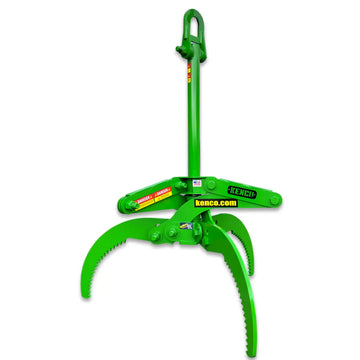
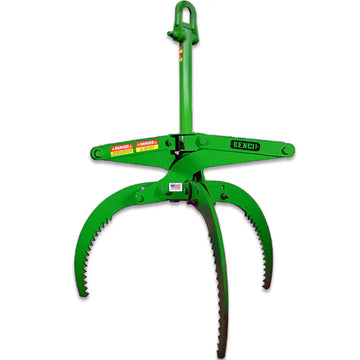
Rock lift attachments: what they do and when to use one
A rock lift attachment is a grapple that hangs from a machine's hook or shackle and closes on a boulder, block or slab so it can be lifted and placed instead of dragged, rolled or hand-rigged. Hardscape and retaining-wall crews, landscape contractors, quarry operators and utility contractors use them to set armor stone and wall block, clear rock from grade, and move rubble that will not stay in a bucket. The three units in this collection are Kenco Rocklift grapples rated 3,000 lb, 6,000 lb and 12,000 lb, and Kenco lists all three for rocks, boulders, debris and irregular loads.
The alternatives each have a real limitation. Chains and slings have to be rigged and unrigged by hand at both ends, which puts a person next to the load twice per cycle. A bucket cannot hold a round rock predictably. A hydraulic thumb works well but occupies the machine's auxiliary circuit and does not hang the load centered under the hook. A mechanical grapple sits between them: no hand rigging at the pick, no hydraulics to plumb.
Comparing the MG3000, MG6000 and MG12000 rock lifts
Two numbers decide the model — how heavy the stone is, and how big around it is. Both have to fit. A rock inside the weight rating but outside the jaw opening is not a load the attachment can take, and that catches buyers more often than capacity does.
| Model | Capacity | Grip range (diameter) | Contact system | Shipping weight |
|---|
| MG3000 (MG3K0T30V4) | 3,000 lb (1,361 kg) | Up to 30 in. (76 cm) | Triple serrated mechanical tines | ~250 lb (113 kg) |
| MG6000 (MG6K15T40V4) | 6,000 lb (2,722 kg) | 15–40 in. (38–102 cm) | Mechanical three-tine grapple | ~400 lb (181 kg) |
| MG12000 (MG12K24T60V4) | 12,000 lb (5,443 kg) | 24–60 in. (61–152 cm) | Three-point mechanical grapple | ~1,000 lb (454 kg) |
Note the minimums. The MG6000 grips from 15 in. and the MG12000 from 24 in., so the largest unit is the wrong tool for small stone even though it is the strongest. The MG3000 has no stated minimum and works up to 30 in. Crews running a wide mix of stone sizes often end up with two units rather than one oversized one. Shipping dimensions also differ enough to matter for storage and transport: roughly 38 x 38 x 53 in. for the MG3000, 52 x 48 x 68 in. for the MG6000 and 115 x 48 x 52 in. for the MG12000.
Mechanical grapples vs. hydraulic and hand-rigged setups
Mechanical rock grapples work off the lifting force itself. The linkage converts the pull of the machine into clamping force at the tines, so grip firms up as the load takes weight and the jaws release when the load is set down and the line goes slack. Kenco specifies all three Rocklift models as mechanical operation, no hydraulics required.
Practically, that means no hoses down the boom, no couplers to leak, no auxiliary flow or pressure to match, and no case-drain question. The same attachment can move between machines that share a hook or shackle connection. The trade-off is that the operator has less direct control than with a hydraulic grapple: placement depends on approach and on the load geometry, and the unit will not squeeze a load that is out of its grip range.
Matching the attachment to your carrier
Capacity on the attachment is only half the calculation. What governs the job is the carrier's rated capacity at the radius and configuration you are actually working in, and the attachment's dead weight comes off that number before the rock does. Read the machine's load chart rather than its headline rating, and use the actual attachment weight from the manufacturer's manual — the figures above are shipping weights, which include packaging.
Also confirm the connection. These hang from a hook or shackle, so the rigging hardware, its rated load and its condition are part of the system. Ground conditions matter for the same reason: a machine that is legal on its chart can still be unsafe on soft or sloped ground, and setting large stone usually means working at radius rather than tucked in tight.
Standards, inspection and operator practice
ASME B30.20 covers below-the-hook lifting devices, which is the category a rock grapple falls into, and it addresses marking the rated load, initial inspection before first use, and periodic inspection with records. ASME BTH-1 is the companion design standard that B30.20 references for structural design categories and service classes. On construction sites, OSHA 1926.251 requires rigging equipment used for material handling to be inspected before use on each shift and taken out of service when it is damaged.
When an excavator is used to hoist loads with rigging rather than to dig, OSHA's cranes and derricks standard for construction, 29 CFR 1926 subpart CC, can apply — worth confirming with your safety officer for your specific application. Regardless of which rule governs, the operating practices are the same: no one under or beside a suspended load, no side loading, no shock loading, and no lifting a rock the jaws only partly close on.
Maintenance and what buyers get wrong
A mechanical grapple has few wear points, and they are all visible: the tines and their serrations, the pivots and pins, the linkage, and the lifting eye or bail. Inspect for cracks at welds, elongated pin holes, bent tines and worn bushings, and follow the manufacturer's manual for lubrication intervals.
- Buying on capacity alone. Grip range disqualifies more loads in practice than weight does.
- Forgetting attachment weight. It reduces what the carrier can lift at radius.
- Guessing at stone weight. Density varies widely by rock type; get the figure from your quarry or material supplier and size up if the estimate is close to the rating.
- Ignoring shape. Flat slabs, smooth rounds and compressible debris behave differently in tines than blocky stone.