Skid Steer Pallet Fork Attachments for Sale Online
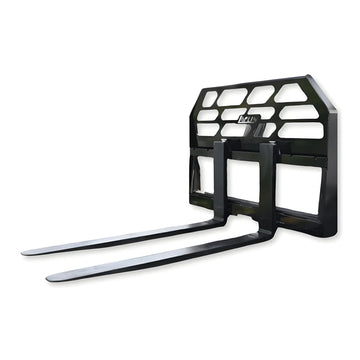
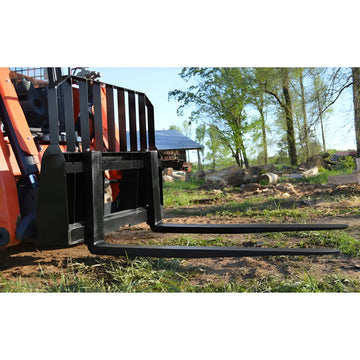
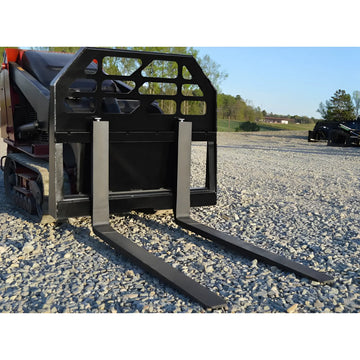
This collection holds seven skid loader pallet fork attachments: six from Loflin Fabrication and one from Star Industries, spanning $37 to $854. Between them you can buy a complete fork-and-frame set, a bare pallet fork frame to pair with tines you already own, a walkthrough frame, hydraulically adjustable forks, or a mini skid steer fork frame. Every figure in the table below comes from our own product data.
| Model | Construction | Lengths / sizes | Adjustment and mount |
|---|
| Loflin Skid Steer Hydraulic Pallet Forks | 1 3/8" x 4" solid forged alloy steel tines, 1/4" plate steel fork guard | 36" to 72", 48" standard | Hydraulically adjustable tine spacing; CNC-machined carriage bar with 3 locking positions |
| Loflin Skid Steer Pallet Forks | Heavy-duty steel, thin frame design | 36", 42", 48" | Standard skid steer quick attach; 3 lock positions; ships fully assembled |
| Loflin Skid Steer Heavy Duty Pallet Forks | 1 3/8" solid forged alloy steel, 1/4" plate steel fork guard | 36", 42", 48", 60", 72" | Universal skid steer quick attach; adjustable spacing, 3 locking positions |
| Loflin Standard Pallet Forks Frame | 3/16" steel, thin frame for closer load placement | 36", 42", 48", 60", 72" | Quick-attach, compatible with most skid steer models; 3 locking positions |
| Loflin Walkthrough Pallet Fork Frame | 4" x 4" square tubing frame, 1 3/8" x 4" forged tines, 1/4" guard | 36", 42", 48", 60", 72" | CNC-machined carriage bar; 3 locking positions; powder-coated |
| Loflin Mini Skid Steer Fork Frames | 1 3/8" x 4" solid forged alloy steel, 1/4" plate steel fork guard | 36", 42", 48" | Stocked with Toro Dingo and Bobcat MT50 mounts; custom mounts available |
| Star Industries Skid Steer Pallet Forks | See product page | See product page | See product page |
Pallet Fork Frame vs. Complete Fork Attachment
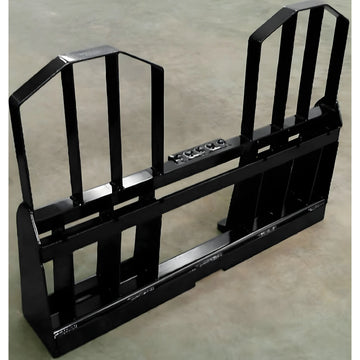
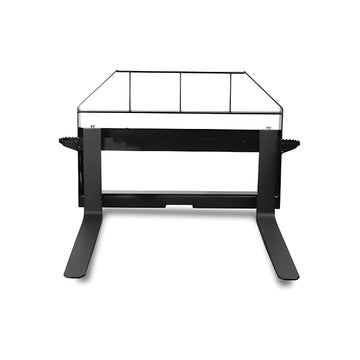
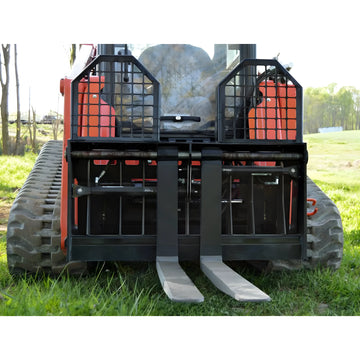
The phrase "pallet fork frame" means the carriage assembly alone — the quick-attach backplate, the carriage bar the tines hang on, and the fork guard — without tines included. Buying the frame by itself makes sense when you already have serviceable forged tines from a retired forklift or an older attachment, or when you want to stock a second frame for a machine that only occasionally handles pallets. A complete attachment, like the Loflin Skid Steer Pallet Forks, arrives fully assembled and ready to use.
- Thin frame versus walkthrough frame. Our Standard Skid Steer Pallet Forks Frame uses 3/16" steel in a thin-frame design that lets the load sit closer to the coupler. The Walkthrough Pallet Fork Frame is built from 4" x 4" square tubing with an open center, which many operators prefer for sight lines to the tine tips.
- Carriage bar quality. All the Loflin frames here use a CNC-machined carriage bar with three locking positions, so tines index into repeatable spacings instead of drifting during a shift.
- Class 2. Several of these frames are listed as Standard Class 2, the ITA fork carriage classification. Match the class of your existing tines to the frame before ordering a frame on its own.
Matching Skid Loader Pallet Forks to the Machine and the Load
Two limits decide what a fork attachment can safely pick up: the tines themselves and the loader. For skid steer loaders, SAE J818 and ISO 14397-1 define rated operating capacity as 50 percent of the machine's tipping load; for compact track loaders the same standards use 35 percent. That rating is measured with a bucket, and forks push the load center farther forward than a bucket does, so effective capacity on forks is always lower than the number on the machine's decal. Consult the loader manufacturer's attachment chart, not just the ROC.
Load center matters for the same reason. ANSI/ITSDF B56.1 rates forklift capacity at a 24" load center; a deep or badly stacked load shifts that center outward and multiplies leverage on the carriage. This is why longer is not automatically better. Our tines are offered from 36" to 72", but the 48" option matches the 48" x 40" GMA pallet published by the Grocery Manufacturers Association, which is the most common footprint in US distribution. Buyers commonly over-buy length, then find the extra tine catches racking, fencing, or trailer walls and adds tip-forward moment they did not want.
Mini Skid Steer Fork Frames and Mount Compatibility
Mini skid steers and stand-on loaders do not share a mounting interface with full-size machines — the plates are physically smaller and the pin and latch geometry differs. Our Mini Skid Steer Fork Frames are stocked with Toro Dingo and Bobcat MT50 mounts, with additional custom mounts available on request, and they use the same 1 3/8" x 4" solid forged alloy steel tines and 1/4" plate steel fork guard as the full-size heavy-duty forks, in 36", 42", and 48" lengths. Before ordering, identify your machine's mount plate by model, not by brand alone, because a single manufacturer may use more than one pattern across its lineup.
Hydraulic Skid Steer Forks vs. Manual Tine Adjustment
Manual adjustment means stepping out of the cab, releasing the lock, sliding each tine along the carriage bar, and re-seating it in one of three positions. That is fine for a yard that handles one pallet size all day. Our Skid Steer Hydraulic Pallet Forks adjust tine spacing from the cab, which pays off when loads change constantly — pallets, then crates, then bundled material — or when the operator would otherwise be dismounting onto mud, ice, or an active work area. The trade-off is a hydraulic circuit to maintain and auxiliary flow the loader must supply, so confirm your machine has functioning auxiliary hydraulics and couplers first.
Safety, Inspection, and Standards
OSHA's powered industrial truck rule, 1910.178, covers forklifts and requires operator training and evaluation; skid steer loaders are generally regulated instead as material handling and earthmoving equipment under OSHA 1926.602 in construction work, alongside the manufacturer's operating instructions. Either way, no one should run a fork attachment without documented training on that specific machine.
For the tines, ANSI/ITSDF B56.1 calls for fork inspection at least annually — more often in severe service — and removal from service when a tine has lost roughly 10 percent of its original thickness at the heel, or when cracks, bent blades, or damaged locking pins appear. Many fleets apply the same rule to loader forks. Check the carriage bar and locking positions on the same schedule, keep the fork guard undamaged, and touch up powder-coated surfaces where steel is exposed to slow corrosion at the wear points.