What a 3D Wheel Alignment Machine Measures
A 3D wheel alignment machine converts the position of wheel-mounted targets or sensors into the angles that actually drive tire wear and steering behavior: toe at each wheel and across each axle, camber, caster, steering axis inclination, and thrust angle — the direction the rear axle is really pointing relative to the vehicle centerline. Toe errors scrub tread off fastest. Camber wears one shoulder and shows up as a diagonal wear pattern. Caster problems present as pull, wander, or a steering wheel that will not return on its own. Measuring all four wheels matters because a rear thrust angle will drag the vehicle off course no matter how carefully the front end is set, and it is the reason a front-toe-only adjustment often comes back as a comeback. In this collection, the Katool KT-AV9 Four-Wheel Optical Sensor Wheel Alignment System publishes its measuring ranges directly: total front beam angle ±6°, front beam angle of a single wheel ±3°, wheel camber ±10°, kingpin rear angle ±15°, kingpin inclination ±20°, and thrust angle ±6°.
3D Camera Aligners vs. Four-Wheel Optical Sensor Systems
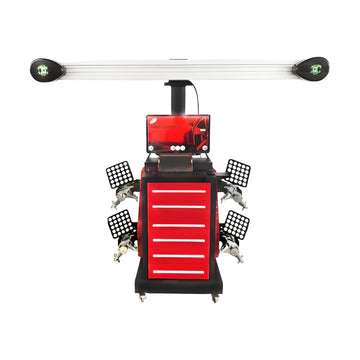
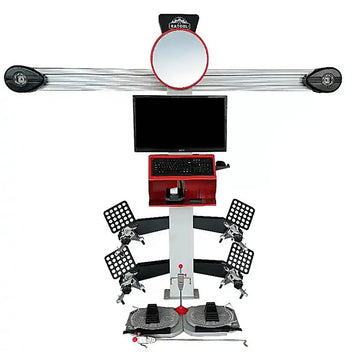
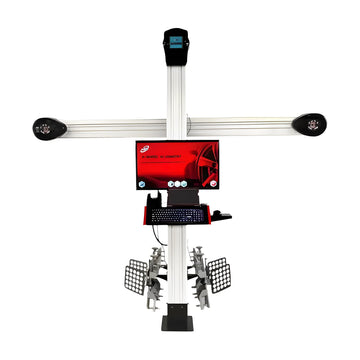
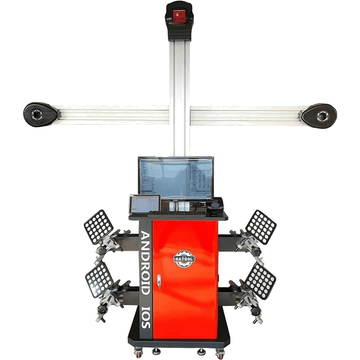
The two approaches in this collection solve the same problem from opposite ends of the bay. Camera-based 3D machines keep the measuring hardware on a beam or cabinet and watch passive targets clamped to the wheels. Nothing at the wheel needs a battery, a cable, or a radio link, so wheel-end handling is light and there is less to damage or charge. The trade is that the cameras need an unobstructed line of sight to every target through the whole measurement, which makes bay layout, lighting and the fixed relationship between the camera beam and the runways part of the buying decision. The Katool AV533 and Katool KT-AV6 are camera machines, both listing dual cameras; the Katool KT-AV651 is a mobile 3D unit specified for use with 2-post and scissor lifts, which is the configuration for shops that do not have a dedicated alignment rack. Optical sensor systems such as the KT-AV9 put the measuring heads on the wheels and measure between them. That makes them less dependent on room geometry and camera sight lines, at the cost of more equipment to mount, protect and keep charged at each corner.
Matching a Wheel Aligner to Your Lift and Bay
Alignment work requires the vehicle to sit level and to settle on its suspension, which is why the conventional setup is an alignment rack or scissor lift with slip plates at the rear and turnplate pockets at the front. If you are buying a 3D wheel alignment machine for a general service bay rather than a dedicated alignment bay, the lift is usually the constraint, not the aligner — check runway length, whether the lift can be leveled to the aligner manufacturer's installation requirement, and whether you have wheel-free access for adjustments. The KT-AV651 is the unit in this collection specified for 2-post and scissor lift use. Plan for the physical handling as well: the KT-AV651 and the KT-AV6 each list a product weight of 440.92 lbs (200 kg) and a shipping weight of 529.11 lbs (240 kg), so receiving and positioning need equipment, not two people. On the lift side, ANSI/ALI ALOIM addresses the inspection and maintenance of automotive lifts, and ALI/ALCTV is the standard under which automotive lifts are certified — worth confirming for the lift the aligner will work over.
Vehicle Coverage: Tire Size, Wheelbase and Track Width
The most common mistake is assuming an aligner covers everything that rolls into the shop. Coverage is bounded by published dimensional ranges, and by whether the software has data for the vehicles you actually service. Three units in this collection list identical dimensional ranges:
| Model | Tire Diameter | Wheelbase | Track Width |
|---|
| Katool KT-AV651 | 9 27/32 – 31 1/2 in. (250–800 mm) | 62 63/64 – 82 43/64 in. (1.6–2.1 m) | 70 55/64 – 177 11/64 in. (1.8–4.5 m) |
| Katool AV533 | 9 27/32 – 31 1/2 in. (250–800 mm) | 62 63/64 – 82 43/64 in. (1.6–2.1 m) | 70 55/64 – 177 11/64 in. (1.8–4.5 m) |
| Katool KT-AV6 | 9 27/32 – 31 1/2 in. (250–800 mm) | 62 63/64 – 82 43/64 in. (1.6–2.1 m) | 70 55/64 – 177 11/64 in. (1.8–4.5 m) |
The KT-AV6 is described for cars and light commercial vehicles. If your work mix includes long-wheelbase vans, duallies or anything outside those listed ranges, ask us to confirm fit against the specific model before ordering rather than assuming the range stretches.
Turnplates, Slip Plates and Setup Discipline
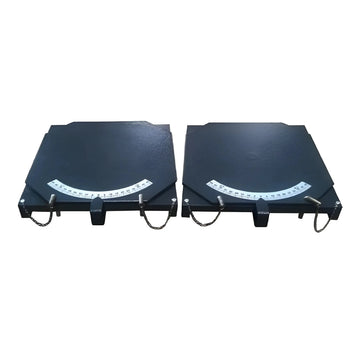
Accuracy is lost in setup far more often than in the measuring head. Caster is not measured directly — it is derived from a steering sweep, and the front wheels have to turn freely while carrying load for that sweep to mean anything. That is what the AMGO 40101 TurnPlate Set is for: low-profile steel rotating plates for alignment and service lifts, sized to sit under the front wheels during alignment and steering adjustments. Without turnplates, side friction binds the tires and the readings are unrepeatable. The rest of the discipline is unglamorous and non-negotiable: perform runout compensation on every wheel, equalize tire pressures, confirm ride height and any specified load condition, jounce the suspension so it settles, lock the steering wheel and brake pedal as the procedure calls for, and pull the turnplate pins only after the vehicle is in position.
Power, Environment and What to Confirm Before You Buy
The KT-AV651 and the KT-AV6 both list a power supply of 100–240V, 50/60 Hz, single phase, and a working temperature range of 41°F–104°F (+5°C to +40°C). That temperature window is a real constraint for an unheated bay in a northern winter, and it is easy to overlook when the rest of the shop equipment tolerates the cold. Both of those units list a 1-Year Limited warranty. Before you commit, confirm four things with us for the specific model: the vehicle data coverage in the software and how updates are handled, the clamp and target style included, what is required for periodic calibration per the manufacturer's instructions, and how the machine will be received and set in place given its weight. If you also perform driver-assistance work, note that alignment and thrust angle are inputs to OEM camera and radar calibration procedures — these machines are sold as alignment systems, so check the individual listing before assuming any ADAS calibration function.