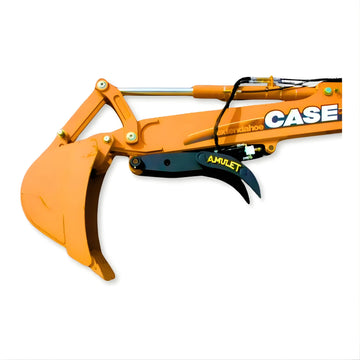
What a Mini Excavator Thumb Does
A thumb is an opposing jaw that mounts on the stick and closes against the bucket, turning the bucket into a gripping tool. Without one, an excavator can only scoop and drag. With one, the same machine picks up logs, root balls, broken concrete, culvert pipe, boulders and demolition debris, and can set them down with control instead of pushing them across the site. On small machines this is usually the single highest-value attachment a contractor adds, because it removes a whole category of hand work from land clearing, storm cleanup, utility trenching and site demolition. The trade-off is that a thumb adds weight to the end of the stick, slightly reduces usable bucket curl in some positions, and needs to be matched to the bucket it will close against.
Hydraulic vs. Manual Excavator Thumbs
Every thumb in this collection is hydraulic. A manual (mechanical) thumb pins into one of several fixed positions and has to be repositioned by hand, which is fine if you clamp occasionally and dig most of the day. A hydraulic thumb is controlled from the cab through an auxiliary circuit, so the operator can feather the jaw open and closed against the load, hold pressure on an irregular object, and swing the thumb fully back out of the way when digging. If you handle material for more than an hour or two a day, hydraulic pays for itself quickly in cycle time and in not stopping to pull pins.
Within hydraulic thumbs there are two geometries, and Geith sells both. A non-linkage or direct-mount thumb, like the Hydraulic Klamp (HK) series, uses a cylinder acting directly on the thumb — simple, fewer wear points, and a good match for machines that mostly clamp bulky material. A progressive linkage thumb, like the Geith PL series, adds a linkage that keeps the thumb tip roughly parallel to the bucket through a much wider arc, so it grips small material and large material with similar force and closes more usefully near the bucket teeth. Amulet's PowerClamp is offered in Non-Linkage, Non-Linkage for Coupler, Linkage and Linkage for Coupler styles, which is the same choice expressed as four configurations.
Mounting: How Excavator Thumbs Attach
Mounting is where most orders go wrong, so settle it before you compare prices. Amulet's PowerBrute is offered with a weld-on base plate, a coupler pin-on arrangement with a weld-on base plate, a Thumb-Ready mount that uses an existing OEM cylinder mount, and Case and John Deere specific mounts. Which one you need depends on your stick, not on your preference.
- Weld-on base plate — the base plate is welded to the stick. Strongest and most universal, but it needs a competent welder and takes the machine out of service for a day.
- Thumb-ready / OEM cylinder mount — many machines built in the last decade leave the factory with thumb brackets and a capped auxiliary line. If yours has them, installation is bolt-and-pin and much faster.
- Coupler pin-on — if you run a quick coupler, the thumb has to be specified for it. A thumb sized for a direct-pinned bucket will not close correctly through a coupler, because the coupler moves the bucket further from the stick.
Sizing a Thumb to Your Machine
Thumbs are selected by machine operating weight first, then by dipper pin diameter and bucket tip radius. Amulet's PowerBrute and PowerClamp both cover 11 excavator weight classes, from the 1–3 ton class through the 40–50 ton class, in 15 configurations. Geith models are published against specific weight bands:
| Model | Machine weight | Key fitment spec |
|---|
| Geith HK08-3208 (Hydraulic Klamp) | 9,000 – 20,000 lb (4.1 – 9.1 tons) | 201 mm / 7.9 in wide, 104 kg / 230 lb |
| Geith PL065 (Progressive Linkage) | 24,251 – 30,865 lb (11.0 – 14.0 tons) | 65 mm / 2.6 in dipper pin; 172.5 bar / 2,500 psi max operating pressure |
| Geith PL070 (Progressive Linkage) | 30,865 – 39,683 lb (14.0 – 18.0 tons) | 70 mm / 2.8 in dipper pin |
Measure your machine's dipper pin diameter and your bucket's tip radius before ordering rather than going by the model name on the side of the cab, because the same model number is often sold with different stick and bucket combinations. Geith publishes a recommended bucket tip radius alongside each thumb for exactly this reason: if the thumb tip and bucket tip do not meet, the attachment will grip poorly no matter how well it is built. Amulet fitment is confirmed against their published fitment chart by make and model.
Hydraulics, Installation and Operation
A hydraulic thumb needs an auxiliary circuit with the right flow and pressure, plus lines run down the stick and protected from abrasion. If the machine already has a breaker or coupler circuit, a diverter valve is usually the cheapest path; if it has nothing, budget for a valve, plumbing and cab controls in addition to the attachment. Do not exceed the attachment's stated maximum operating pressure — the Geith PL065, for example, is rated to 2,500 psi.
On the operating side, a thumb is a clamping tool, not a crane. ISO 10567 is the standard that defines how hydraulic excavator lift capacity is rated, and those ratings assume a load hanging from a designated lift point, not a load pinched between bucket and thumb. When an excavator is used to hoist a suspended load with rigging, OSHA's crane and derrick standard at 29 CFR 1926 Subpart CC applies. Clamping debris to move it a few feet is normal use; slinging a load over people is not. Keep loads tucked in close to the machine, and remember that anything held out at full reach is working against stability.
Excavator Thumb Parts, Wear and Maintenance
Thumbs live in abrasive material and take shock loading, so the wear items are predictable: pins and bushings at the pivot and cylinder ends, the cylinder rod and seals, hoses at the flex point near the stick, and the tips of the thumb tines themselves. Grease the pivots on the interval in the manufacturer's manual, check pin retention hardware weekly, and watch for elongated pin bores — that is the first sign a thumb is being loaded harder than it was sized for. Twisting the stick sideways to break material free is the most common way operators damage both the thumb and the machine, because side loading is the one thing the boom and stick are not designed to take.