What a Tracked Spider Lift Does That a Boom or Scissor Lift Cannot
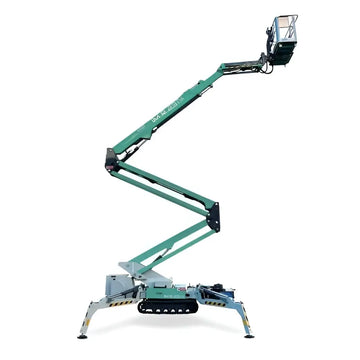
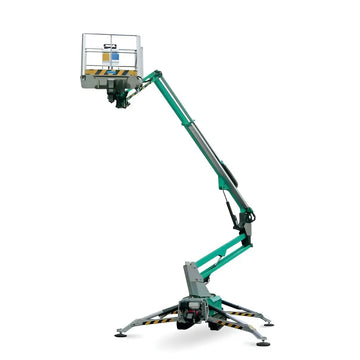
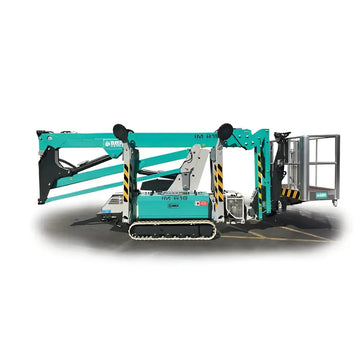
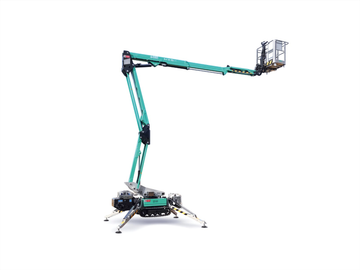
A spider lift is a boom-type aerial platform on a rubber-tracked, articulating undercarriage. Instead of driving on wheels and relying on machine weight for stability, it tracks into position at low ground pressure, deploys outriggers, and works from a fixed footprint. That combination solves three problems at once: getting through an opening a self-propelled boom lift will never fit through, crossing surfaces a wheeled machine would rut or crack, and reaching over obstacles such as pews, planters, machinery or landscaping. Every unit in this collection uses a hydraulically adjustable-width track undercarriage, so the travel width for entry is narrower than the working footprint after setup. Buyers most often compare spider lifts against towable boom lifts and truck-mounted platforms; the spider wins where the machine has to move itself over rough or delicate ground without a tow vehicle.
Choosing Working Height and Outreach on a Tracked Spider Lift
Height alone is the wrong way to spec one of these machines. Two numbers matter more: platform height (where your feet actually stand) and horizontal outreach (how far sideways you can work from the setup position). Working height is conventionally platform height plus a nominal allowance for a standing operator, so the 75 ft IM R 23 lists 68 ft of platform height. Outreach is what determines how many setups a job takes — if you can reach 39 ft sideways, you reposition far less often than a machine limited to 23 ft. Note that outreach is load dependent on boom lifts generally, and the IM R 19 EVO listing states this explicitly.
| Model | Working Height | Platform Height | Outreach | Power Source |
|---|
| IM R 23 (SKU 1128633) | Up to 75 ft (22.85 m) | 68 ft | Up to 39 ft | Diesel |
| IM R 19 Li (SKU 1128772) | 62 ft | 56 ft | 32 ft max side reach | Lithium batteries |
| IM R 19 EVO (SKU 1128770) | 62 ft | 56 ft | 32 ft (load dependent) | All-electric, battery powered |
| IM R 15 DA Li (SKU 1128760) | 49 ft (49'6") | — | 23 ft side outreach (7 m) | Lithium battery (zero emissions) |
Basket capacity is the other constraint people underestimate. Two workers plus tools and material adds up quickly, and on boom lifts capacity typically falls as the boom extends toward maximum outreach. The IM R 15 DA Li lists a 506 lb basket capacity; confirm the rated capacity chart for any model against your actual crew and payload before you buy.
Diesel, Electric and Lithium Spider Lifts
Power source is usually the deciding factor once height is settled. The IM R 23 is listed as a Diesel | Electric machine with diesel as its power source — the right choice for outdoor work, remote sites and long duty days where refueling beats recharging. The IM R 19 EVO is all-electric and battery powered, and the IM R 19 Li and IM R 15 DA Li run on lithium batteries, which is what you want for interior work, occupied buildings, food and pharmaceutical facilities, and any site with emissions or noise restrictions. The IM R 15 DA Li is listed with both a Honda iGX390 engine and a 120 volt electric motor alongside its lithium pack, giving it more than one way to run.
Lithium packs matter more than the word "electric" suggests. Compared with flooded lead-acid, they take opportunity charging without the same penalty, do not require watering, and hold voltage more consistently through a shift — which on a boom lift shows up as consistent boom speed late in the day rather than a machine that gets sluggish. Against that, diesel remains simpler for continuous outdoor production work.
Site Requirements: Access, Setup and Ground Conditions
Measure the tightest point on the route before you buy, not the door you are working through. Gate posts, elevator car depth, stair-turn landings, floor loading limits and overhead clearances all constrain which machine can physically arrive. Then plan the setup: a spider lift transfers nearly all of its weight through four outrigger feet, so ground bearing pressure at each foot is far higher than the track pressure during travel. Outrigger pads spread that load, and any setup over a basement, vault, drain, backfilled trench or fresh slab needs to be reviewed by someone who knows the structure's capacity. On slopes, automatic leveling outriggers do the work of squaring the machine — the IM R 23 and IM R 19 EVO both list automatic leveling outriggers, and IMER lists proportional controls with diagnostic feedback on both, plus removable wired and wireless control on the IM R 23.
Turret rotation determines how much of the work envelope you can cover from one setup. The IM R 19 Li and IM R 15 DA Li both list 355° non-continuous rotation, which means the turret cannot spin indefinitely in one direction and the operator has to plan boom position accordingly.
Operator Training, Fall Protection and Applicable Standards
Aerial lifts are regulated equipment. OSHA 29 CFR 1926.453 covers aerial lifts in construction and requires that a body belt be worn with a lanyard attached to the boom or basket when working from an aerial lift; OSHA 29 CFR 1910.67 addresses vehicle-mounted elevating and rotating work platforms in general industry. On the consensus-standard side, ANSI/SAIA A92.20 covers the design and manufacture of mobile elevating work platforms, ANSI/SAIA A92.22 covers safe use — including site risk assessment and a rescue plan — and ANSI/SAIA A92.24 covers training requirements for operators, supervisors and occupants. Budget for training and for a documented safe-use program the same way you budget for the machine.
Total Cost and Common Buying Mistakes
Spider lifts in this collection run from $117,705 to $177,650, so the purchase decision usually has to survive a comparison against renting. The math tends to favor buying when the machine is in regular use, when mobilization of a rental to your sites is slow or expensive, or when the access problem is specific enough that rental yards do not stock a suitable unit. The most common mistakes are buying on working height alone and discovering the outreach is short for the job; ignoring basket capacity for a two-person crew; and failing to plan outrigger setup on the actual surfaces the machine will work over. The second most common is choosing diesel for a building that will not permit it, or battery for a remote outdoor site with no reliable charging.