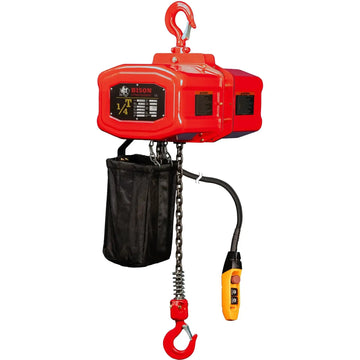
Electric Hoists: What This Collection Covers
The 35 electric hoists on this page come from two manufacturers and serve two fairly different jobs. Bison Lifting accounts for 32 of the listings and covers production lifting — 1/4 ton up to 10 ton, in single-phase and three-phase, single-speed and dual-speed, sold as bare hoists or bundled with a push trolley. Vestil accounts for three product families aimed at lighter work: the MINI cable hoists (8 models, $161.14–$643.23), the EMH electric mini hanging cable hoists (4 models, $954.98–$1,447.80, including the 300 lb EMH-3, 500 lb EMH-5 and 700 lb EMH-7), and the variable-speed electric chain hoists (3 models, $2,898.97–$3,220.19, including the 250 lb VS-ECH-2-1PH and 500 lb VS-ECH-5-1PH). All three Vestil families are made in the USA by Vestil Manufacturing and carry a 1-year limited warranty.
Because the Bison line is organized by configuration rather than by a single model number, it helps to see which capacities exist in which build:
| Configuration | Capacities listed |
|---|
| Single Phase Hoist | 1/4, 1/2, 1, 2, 3, 5 ton |
| Three Phase Hoist | 1/4, 1/2, 1, 2, 3, 5 ton |
| Three Phase Hoist – Dual Speed | 1, 2, 3, 5, 10 ton |
| Hoist + Trolley | 1/4, 1/2, 1, 2, 3, 5 ton |
| Three Phase Hoist + Trolley | 1, 2, 3, 5 ton |
| Three Phase Hoist + Trolley – Dual Speed | 1, 2, 3, 5, 10 ton |
Sizing Capacity and Duty Cycle Before You Compare Prices
Rated capacity is the easy part: the hoist has to exceed the heaviest load it will ever see, including the rigging — slings, spreader bars, below-the-hook devices and the lifting beam all count against the rating, and buyers routinely forget this. The harder part is duty cycle. The Hoist Manufacturers Institute publishes duty service classes H1 through H4 that describe how heavily a hoist is worked; a unit sized for occasional maintenance lifts and a unit feeding a machining cell every few minutes are not interchangeable even at identical tonnage. Under-specifying duty is the most common cause of premature motor and brake wear on an otherwise correctly sized hoist.
Also plan lift height and hook path before ordering. Chain or rope length determines usable lift, and the distance from the beam flange to the hook at full up-travel — headroom — determines how high you can actually get a load off the floor. The Bison 5 Ton Three Phase Hoist + Trolley – Dual Speed is specified as a low-headroom design, which matters in buildings where the beam sits close to the roof structure.
Single Phase vs Three Phase: Match the Hoist to Your Building
This is the decision that most often gets reversed after delivery. Bison offers single-phase hoists from 1/4 ton to 5 ton and three-phase hoists from 1/4 ton to 10 ton, so above 5 ton the choice is made for you. Below that, the deciding factor is what your service panel actually supplies. The three-phase Bison models listed here are dual voltage at 230V/460V, which gives you flexibility across plants, but a shop with only single-phase service cannot run them without a phase converter or transformer — an expense that frequently exceeds the price difference between the two hoists. Confirm available phase, voltage and branch-circuit capacity before you buy; NFPA 70 (the National Electrical Code) governs how the drop and disconnect are installed, and that work belongs to a licensed electrician.
Dual-speed models add a slow approach speed alongside the fast travel speed. That matters for precise setdowns, mating parts on an assembly fixture, or any lift where a load swinging at full speed into position is a safety problem. If your operators spend more time positioning than hoisting, dual speed usually pays for itself in cycle time and damaged-part avoidance.
Trolleys, Beams and Mounting
A bare hoist is fixed to one point. Add a push trolley and the hoist travels the length of the beam, turning a single lift point into a working line. Bison offers trolley-equipped packages across most of the range, including 10 ton in the three-phase dual-speed build. Before ordering a trolley, verify the beam flange width and thickness so the trolley adjusts to fit, and confirm the beam itself is rated for the combined load plus impact — the structure, not the hoist, is usually the limiting factor in older buildings. ASME B30.11 covers monorails and underhung cranes, which is the runway your trolley will ride on, and ASME B30.16 covers overhead underhung and stationary hoists themselves. If you are unsure whether an existing beam can take the load, a structural engineer's sign-off is cheaper than a failure.
Environment, Safety Devices and Operator Requirements
Environment limits are real. The Bison three-phase dual-speed models on this page are specified for an operating temperature of -4° to +104° F with recommended humidity of 85% or less, which rules out unheated deep-freeze applications and washdown areas without further protection. Standard electric hoists are also not rated for classified hazardous locations; if you are lifting near flammable vapors or combustible dust, that is a different product category entirely.
On the safety side, the Bison models detailed here include overload protection (a friction clutch on the 10 Ton Three Phase Hoist + Trolley – Dual Speed), upper and lower mechanical paddle limit switches, a pull-rotor motor brake, an E-stop and a pendant control, in a die-cast aluminum body. Those devices are protection of last resort, not a substitute for procedure. OSHA 29 CFR 1910.179 addresses overhead and gantry crane operation and inspection, OSHA 1910.184 covers the slings you rig with, and OSHA 1910.147 requires lockout/tagout before anyone services the unit. ASME B30.16 sets the frequent and periodic inspection framework for hoists and requires that a designated person perform them.
Maintenance and Total Cost
Running cost on an electric hoist is dominated by three things: the brake, the load chain or wire rope, and the contactors. All three wear faster when the hoist is inched, jogged or plugged repeatedly — another argument for dual speed on high-cycle work. Budget for chain or rope replacement as a consumable rather than a failure, keep the hook throat and latch under regular inspection, and keep the pendant cable out of the load path where it gets pinched. The Bison 3 Ton Three Phase Hoist – Dual Speed carries a 12-month warranty; the Vestil families carry a 1-year limited warranty. Check the individual product page for the terms that apply to the exact model you are configuring.