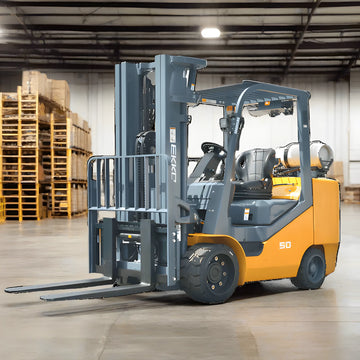
Compare propane forklifts: capacity, tires, engine and price
| Model | Rated capacity | Tires | Lift height | Engine | Price |
|---|
| EKKO EK25SLP | 5,000 lb | Pattern cushion | 189 in | Mitsubishi 4G64, 63 HP | $30,589.05 |
| EKKO EK25TLP | 5,000 lb | Solid pneumatic | 185 in | Kubota or PSI 2.4L, 63 HP | $31,919.05 |
| EKKO EK30SLP | 6,000 lb | Pattern cushion | 189 in | Mitsubishi 4G64 (PSI), 64 HP | $31,919.05 |
| EKKO EK30LP | 6,000 lb | Pneumatic | 189 in | Kubota WG2503, 58.3 HP | $33,249.05 |
| GNT GLP 40-85 | 4,000-8,500 lb | Solid pneumatic | 185 in | PSI 2.4, 63 HP | $33,059.05-$46,834.05 |
| EKKO EK40TLP | 8,500 lb | Solid pneumatic | 185 in | Kubota or PSI 2.4L, 63 HP | $43,889.05 |
| EKKO EK50LP | 10,000 lb | Pattern cushion | 185 in | Kubota WG3800, 63.2 HP | $59,849.05 |
Prices and specifications are taken from each product page; open the listing for current pricing and options.
Propane forklifts for sale: what is in this collection
This page lists 11 active propane forklifts from EKKO (10 models) and GNT (1), priced from $30,589 to $59,849. Capacities start at 4,000 lbs on the EKKO EK20TLP and top out at 10,000 lbs on the EKKO EK50LP, all rated at a 24 in load center. Mast lift heights are 185 in or 189 in depending on model. Tire options cover pattern cushion for smooth indoor concrete, pneumatic for outdoor work, and solid pneumatic for yards with debris. The four-wheel T-series (EK20TLP, EK25TLP, EK30TLP, EK35TLP, EK40TLP) runs solid pneumatic tires across 4,000, 5,000, 6,000, 7,000 and 8,500 lbs.
Published specifications for the models with full spec sheets:
| Model | Capacity (24 in load center) | Lift height | Tire | Overall width | Service weight |
|---|
| EKKO EK25SLP | 5,000 lbs | 189 in | Pattern cushion | 42 in | 9,370 lbs |
| EKKO EK30SLP | 6,000 lbs | 189 in | Pattern cushion | 44 in | 10,785 lbs |
| EKKO EK30LP | 6,000 lbs | 189 in | Pneumatic | 48.2 in | 10,320 lbs |
| EKKO EK35LP | 7,000 lbs | 189 in | Solid pneumatic | 48.2 in | 10,605 lbs |
| EKKO EK50LP | 10,000 lbs | 185 in | Pattern cushion | 55.9 in | 16,250 lbs |
| GNT GLP 40 to 85 | 4,000 to 8,500 lbs | 185 in | Solid pneumatic | 45.2 in | 8,465 lbs |
The GNT GLP is offered in five capacity steps (GLP 40, 50, 60, 70 and 85) on a 62.9 in wheelbase, which makes it the simplest way to standardize one chassis across several load ratings.
Why forklifts run on propane instead of gasoline
Three practical reasons keep LP gas forklifts in service. Fuel handling: propane is stored as a liquid in a sealed cylinder, so an operator exchanges an empty tank in a couple of minutes with no dispensing pump, no spillage and no fuel going stale between seasons. Where the truck can work: LP combustion is cleaner than diesel, and propane trucks are commonly permitted indoors in ventilated buildings where diesel units are not, then driven straight out to the yard. Uptime: engine output does not taper as the cylinder empties, and there is no charging room, battery-change stand or opportunity-charging schedule to build around. That last point is why multi-shift operations with no room for a battery bay usually land on propane rather than electric.
The trade-off is that a propane powered forklift is still an internal combustion truck. It produces carbon monoxide, it needs ventilation, and it needs the engine and exhaust maintained rather than treated as sealed. OSHA has set a permissible exposure limit for carbon monoxide of 50 ppm as an 8-hour time-weighted average under 29 CFR 1910.1000, and cold-weather months with the doors shut are when indoor operations get into trouble.
Cushion, pneumatic or solid pneumatic tires
Tire type decides where the truck can go and how much aisle it eats. Pattern cushion tires are solid rubber pressed onto the wheel, giving the tightest chassis and the lowest ground clearance: the EK25SLP is 42 in wide, 136.8 in long with forks, and has 3.5 in minimum ground clearance at the mast. That is a smooth-concrete truck. Pneumatic tires are air-filled and absorb rough surfaces, but the chassis grows: the EK30LP carries the same 6,000 lbs rating as the cushion EK30SLP while measuring 48.2 in wide against 44 in, and 150.3 in long with forks against 140 in. Solid pneumatic tires keep the pneumatic profile without the puncture risk, which is the right call for yards with scrap, nails or broken asphalt; the EK35LP and the whole T-series use them.
Measure your narrowest working aisle and your loading dock approach before choosing. A cushion truck bought for a gravel yard will bottom out and beat up the operator; a pneumatic truck bought for a tight warehouse costs you aisle width you cannot get back without re-racking.
Sizing capacity, load center and lift height
Every rating on this page is stated at a 24 in load center. A load whose center of gravity sits further out than 24 in derates the truck, and so does lifting to full mast height on some units, so read the data plate on the specific machine rather than the headline number. Attachments matter just as much: a side shifter, fork positioner or clamp adds weight ahead of the front axle and cuts net capacity. OSHA 1910.178(a)(4) requires the manufacturer's prior written approval for modifications and attachments that affect capacity or safe operation, and the truck's markings and nameplate must be updated to match.
Check the building, not just the load. Confirm free lift and lowered mast height against door openings and trailer roofs before you order a 185 in or 189 in mast. Then check floor loading: service weights here range from 8,465 lbs on the GNT GLP to 16,250 lbs on the EK50LP, before you add the load. That combined weight is what crosses your dock plate, mezzanine or trailer floor, and it is the number most buyers forget to verify.
Forklift propane tanks, refueling and storage
A forklift propane tank is a horizontal liquid-withdrawal cylinder that sits in a bracket at the rear of the truck. A locating pin engages the collar so the internal dip tube stays at the bottom and the engine draws liquid fuel, which is why a vertical grill-style vapor cylinder is not interchangeable. The cylinder feeds through a service valve and hose to a regulator and vaporizer, and a pressure relief valve protects the tank.
You can run on cylinder exchange or fill on site. Either way, OSHA 1910.178(f)(1) requires that LP-Gas storage and handling for powered industrial trucks follow NFPA 58, and OSHA 1910.110 covers storage and handling of liquefied petroleum gases at the facility level. Practically, that means a designated changeout location away from ignition sources, cylinders stored in their intended orientation in a ventilated cage, and clear separation from exits and stairwells. Budget for the cylinder fleet and the cage as part of the purchase, not as an afterthought.
Operator training, inspection and common buying mistakes
OSHA 1910.178(l) requires employers to train and evaluate every operator on the specific truck type and workplace conditions before unsupervised operation, with a re-evaluation at least once every three years and refresher training after an accident, near miss or unsafe operation. OSHA 1910.178(q)(7) requires trucks to be examined before being placed in service and at least daily, or after each shift where trucks run around the clock. ANSI/ITSDF B56.1 is the companion safety standard covering the design and operation of high and low lift trucks.
The mistakes we see most on propane forklift quotes: choosing tire type from price instead of floor surface; ignoring overall width against the aisle; assuming nameplate capacity survives an attachment; and treating ventilation and CO monitoring as optional in a building that was fine with two trucks and is now running six. Sort those four out first, then pick the model.
Propane Forklifts: Frequently Asked Questions
How much does a propane forklift cost?
New propane forklifts in this collection are listed from $30,589.05 (EKKO EK25SLP, 5,000 lb) to $59,849.05 (EKKO EK50LP, 10,000 lb). Cost tracks capacity, tire type and mast height. Freight, a cylinder fleet and an approved storage cage are separate line items, so budget past the sticker before you compare quotes.
Why do forklifts run on propane instead of gasoline?
Because propane is easier and safer to handle in a work setting. It is stored as liquid in a sealed cylinder that an operator swaps in a few minutes, with no dispensing pump, no spillage and no fuel degrading during seasonal storage. Combustion is cleaner than gasoline or diesel, which is why LP trucks are commonly allowed indoors in ventilated buildings where diesel units are not.
Do propane forklifts give off carbon monoxide?
Yes. Any internal combustion engine, including LP, produces carbon monoxide, and it builds up fastest in cold weather when the doors stay shut. OSHA's permissible exposure limit for carbon monoxide under 29 CFR 1910.1000 is 50 ppm as an 8-hour time-weighted average. Keep the building ventilated, keep the engine tuned and the exhaust tight, and monitor CO where trucks run indoors for full shifts.
Why do some forklifts use propane rather than electric?
Propane suits operations that run long shifts and move between indoors and the yard. There is no charging room, no battery-swap station and no mid-shift downtime; an empty cylinder is exchanged and the truck keeps working, and engine power does not taper as fuel is used. Pneumatic and solid pneumatic models here also handle rough outdoor surfaces most electric warehouse trucks are not built for.
What kind of propane tank does a forklift use?
A forklift uses a horizontal liquid-withdrawal cylinder mounted on a bracket at the rear of the truck. A locating pin engages the collar so the internal dip tube stays at the bottom and the engine draws liquid, not vapor, which means a vertical grill-style tank will not work. Cylinder specifications are not published on these product pages, so confirm with us what ships with a given model.
How should forklift propane cylinders be stored?
OSHA 1910.178(f)(1) requires LP-Gas storage and handling for powered industrial trucks to follow NFPA 58, and OSHA 1910.110 covers storage and handling of liquefied petroleum gases more broadly. In practice that means a designated exchange point, cylinders secured in their intended position in a ventilated cage, away from exits, stairwells and ignition sources. Check your local fire code as well.
Should I choose cushion or pneumatic tires?
Choose cushion tires for smooth indoor concrete and pneumatic or solid pneumatic for asphalt, gravel and mixed yards. Cushion models are narrower and shorter: the EKKO EK25SLP is 42 in wide with 3.5 in minimum ground clearance at the mast, while the pneumatic EK30LP is 48.2 in wide. If the truck crosses a broken yard daily, the extra width buys ride quality and clearance you will need.
Do operators need certification to run an LP forklift?
Yes. OSHA 1910.178(l) requires employers to train and evaluate operators of powered industrial trucks before they operate one unsupervised, with an evaluation at least once every three years and refresher training after an accident, near miss or observed unsafe operation. Training must cover the specific truck type and your site's conditions. ANSI/ITSDF B56.1 is the companion safety standard for high and low lift trucks.
How much does a 5,000 or 6,000 lb propane forklift cost?
5,000 lb models: EKKO EK25SLP (cushion tires) $30,589.05, EKKO EK25TLP (solid pneumatic) $31,919.05 and GNT GLP50 $34,436.55. 6,000 lb models: EKKO EK30SLP (cushion) $31,919.05, EKKO EK30LP (pneumatic) $33,249.05 and GNT GLP60 $35,814.05. Each listing shows the current price and full specification.
Do you sell used propane forklifts?
No. Every propane forklift in this collection is listed as a new machine from EKKO or GNT, with the specification sheet on its product page.