Cranes and Hoists: How the Categories Differ
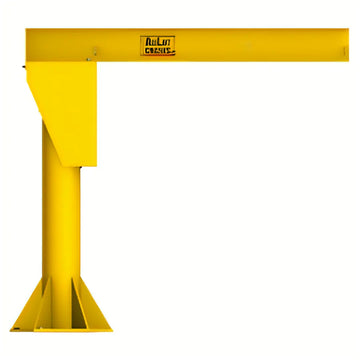
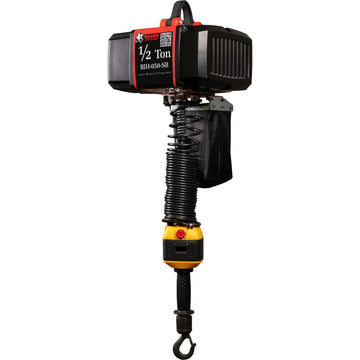
A crane is the structure that carries the load and defines where it can travel. A hoist is the powered unit that raises and lowers it. Most installations are bought as a pair: a jib crane hoist setup, for example, is a boom that swings through an arc plus an electric hoist that runs along it. Read each product page closely, because structures and hoists are frequently sold as separate items, and the hoist you choose has to suit the beam it will ride.
| Type | Coverage pattern | Best fit |
|---|
| Floor-mounted jib crane | Arc around a fixed mast | One machine, press or workstation with repeat picks |
| Wall-mounted articulating jib | Arc along a wall or column, with a second pivot | Reaching around obstructions where floor space is committed |
| Foundationless jib crane | Arc around a bolted base | Leased buildings or slabs where a poured footing isn't practical |
| Portable jib crane | Arc, relocated by forklift | Work that shifts between bays or job sites |
| Gantry crane | Rectangle under the beam | Yards, docks and bays with no usable building steel overhead |
| Electric hoist and trolley | Vertical lift plus travel along a beam | Pairing with any of the above, or an existing monorail |
Sizing a Jib Crane Hoist: Capacity, Span and Hub Height
Three numbers decide the crane: rated capacity, span (how far the boom reaches from the mast) and hub height (how tall the unit stands). Jib cranes listed here include 1/8, 1/4, 1/2, 3 and 5 ton capacities, gantry cranes 2, 4 and 5 ton, and a top running cell crane at 1 ton. Bison Lifting electric hoists are listed at 1, 2, 3, 5 and 10 tons.
Hub height is not hook height. Subtract the hoist body, the trolley, the hook block and your rigging from the hub height to find what you can actually clear. Configuration options are usually a grid rather than a single size: the All Lift Cranes MC-Series Portable Jib Crane at 1/2 ton capacity is offered at 8, 10 and 12 ft hub heights against 8, 10 and 12 ft spans, with listed weights from 5,867 lb for the 8 ft / 8 ft MC188 to 8,114 lb for the 12 ft / 12 ft MC11212.
Rated capacity has to cover more than the part. ASME B30.20 covers below-the-hook lifting devices, and the weight of a spreader beam, vacuum lifter or C-hook counts against the crane's rating, as does rigging weight; ASME B30.9 addresses slings.
Electric Jib Crane Hoists: Power Supply, Speed and Duty
Power supply is the first filter, because it is the hardest thing to change after delivery. Bison Lifting offers both single-phase and three-phase units in this collection at 5 tons, and the three-phase 10 ton hoists are listed as dual voltage at 230V/460V. Confirm what service is actually available at the column where the crane will sit before ordering; NFPA 70 (the National Electrical Code) governs the branch circuit and disconnect work, which is an electrician's scope, not a delivery item.
Dual-speed models give a slow spotting speed for placing a load and a faster speed for the rest of the travel, which matters when operators are landing parts into fixtures. Listed features on the 10 Ton Three Phase Hoist + Trolley - Dual Speed include a die-cast aluminum body, a pull-rotor motor brake, friction clutch overload protection and mechanical paddle upper and lower limit switches, with an operating temperature range of -4° to +104° F and recommended humidity of 85% or less. The 10 Ton Three Phase Hoist - Dual Speed lists a 12-month warranty and an ergonomic pendant control. Those environmental limits are worth checking against unheated warehouses and outdoor bays.
Match duty to how the crane will be worked, not just to the heaviest load. The Hoist Manufacturers Institute (HMI) duty service classifications describe how frequently and how hard a hoist is expected to run, and a unit sized only to nameplate capacity but run on a near-continuous cycle wears out early.
Mobile Hoist Cranes and Gantries: What a Moving Crane Really Weighs
Portable does not mean light. Across the All Lift Cranes MC-FAR Series portable articulating jib cranes, listed unit weights run from 2,776 lb up to 8,670 lb, because the counterweighted base is what keeps the boom from tipping. That is a forklift move with a rated truck and a planned route, not something a crew rolls into place.
Gantry cranes are the more genuinely mobile option: this collection lists adjustable-height aluminum gantries at 2 ton and fixed-height and telescoping steel gantries at 4 and 5 ton. Adjustable and telescoping models let you drop the beam to clear a doorway and raise it again for the lift. Casters demand a flat, sound floor; expansion joints, floor drains and cracked slabs are where gantry projects go wrong. For outdoor use, plan for wind loading and corrosion, and secure the unit when it isn't in service.
Foundations, Installation and Inspection
Mast-style jib cranes generally need an engineered footing built to the manufacturer's foundation drawing. Foundationless models bolt to an existing slab, but the slab still has to be verified for thickness, strength and condition against that manufacturer's spec by a qualified engineer, and wall-mounted jibs transfer a substantial overturning moment into building steel, which is a structural review, not a judgment call.
On the compliance side, OSHA 1910.179 covers overhead and gantry cranes, including inspection before initial use and ongoing frequent and periodic inspections, and requires that only designated persons operate the equipment. ASME B30.16 addresses overhead underhung and stationary hoists, ASME B30.11 covers monorails and underhung cranes, and OSHA 1910.184 covers slings. Budget for installation, an electrical connection and a load test as part of the delivered cost.
What Buyers Most Often Get Wrong
The three recurring mistakes: buying to load weight alone and ignoring duty cycle; measuring to steel and forgetting that the hoist and rigging eat several feet of hook height; and assuming a crane and a hoist arrive together when the listing covers one of them. A fourth is freight. These are heavy, oversized items, and a receiving plan with the right forklift or rigging crew on site should be arranged before the truck arrives.