Choosing a Pool Removal Grapple Attachment
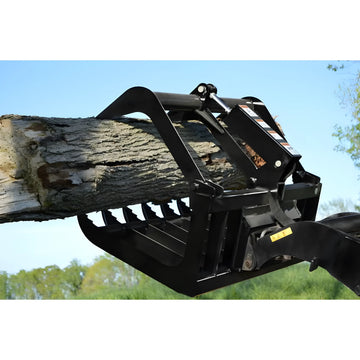
Pool removal is two jobs in one. First the gunite or concrete shell and the surrounding deck get broken up, usually by hammering or ripping. Then the rubble, the rebar mat, the plumbing and the liner have to be picked, separated and loaded. A grapple is what turns the second half from hand work into machine work, and it is the part of the job most people underbuy for. What matters is jaw opening, tine spacing tight enough to hold a tangled rebar mat instead of letting it slip through, and a carrier heavy enough to stay planted while the jaws close on a load.
For full-depth removal on an excavator, the Geith Mechanical Excavator Grapple in this collection is designed for 18–41 ton excavators and is intended for demolition, waste handling and bulk material applications. For partial removal, backfill cleanup, and yards where access is limited to a gate opening, a skid steer or mini skid steer grapple is the practical choice. One regulation applies directly: OSHA's respirable crystalline silica standard for construction, 29 CFR 1926.1153, covers demolition tasks that fracture silica-containing material such as concrete, and identifies operating equipment from an enclosed cab as one of the recognized control methods. Most municipalities also require a demolition permit and an inspection for pool removal — confirm the process with the local building department before the machine shows up.
Root Grapples, Rock Grapples, Grapple Buckets and Stump Buckets
The names get used loosely, but the floor design is what actually separates them, and the floor design is what determines whether material stays in the attachment or falls out on the way to the truck.
| Type | Floor design | Best suited to |
|---|
| Root grapple | Open or flat floor between tines | Brush, roots, storm debris, land clearing |
| Rock grapple / rock bucket grapple | Skeleton floor that sifts soil out | Rock picking, demolition rubble, separating dirt from debris |
| Grapple bucket | Solid bucket floor with a clamp lid | Loose mixed debris, spoil and material you do not want to lose |
| Stump bucket | Narrow, long, toothed | Digging out stumps, roots and buried rock |
| Universal grapple adapter | Bolts clamping onto a bucket you already own | Adding grapple function without buying a new bucket |
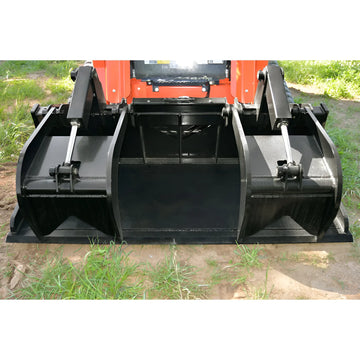
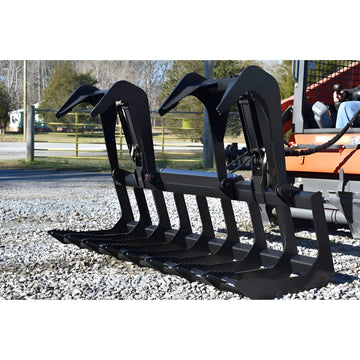
The catalog makes the differences concrete. The Loflin Fabrication Mini Rock Bucket uses an open skeleton design for debris sifting, 3/8" thick steel construction and a ¾" x 36" welded cutting edge, is offered in 36" to 48" sizes, and has three adjustable locking positions on a reinforced quick-attach system that is universal to mini skid steers. The Loflin Fabrication Mini Skid Steer Grapple Bucket is a solid-floor design with a 36.5 in grapple opening width, fitting compact tractors, compact track loaders and mini skid steers. The Loflin Fabrication Monster Root Grapple is rated for clamping force up to 7,500 lbs on machines of 75 HP or less, with a flat floor design and versatile tine spacing. The Loflin Fabrication Skid Steer Stump Bucket is narrower than an average skid steer bucket for deeper ground penetration and longer than average for extra leverage, with three replaceable teeth on the bottom.
Matching a Grapple to Your Carrier
Start with the machine, not the attachment. Mini skid steers and full-size skid steers use different quick-attach plates, so a full-size grapple will not simply bolt onto a mini — check which plate the attachment is built for before ordering. Horsepower and hydraulic pressure set the realistic ceiling on clamping force; the Monster Root Grapple, for example, is specified for machines of 75 HP or less, which is a compatibility statement as much as a capability one.
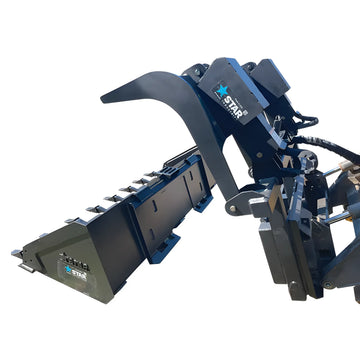
Every grapple needs auxiliary hydraulics at the front of the machine. If your loader was ordered without them, that is a retrofit cost to price before the attachment. Coupler style matters too: flat-face couplers and older pioneer-style couplers do not mate, and mismatches are the most common reason a new attachment sits unused for a week. Loflin Fabrication grapples in this collection include Parker hose and fittings, and the Star Industries Universal Grapple Adapter (model 175-UGA / 175-UG) ships with flat-face coupler hoses. That adapter is a quick-tach unit that attaches to the rear of a skid-steer bucket, built with a 3/8" quick attach plate, ½" grapple thickness and 2" x 10" x 1¼" heavy-duty welded cylinders — a way to add clamping to a bucket you already run.
Finally, remember that attachment weight sits out at the end of the loader arms. Heavier steel means better durability and worse stability, and it eats into what the machine can safely pick up. Consult the carrier manufacturer's rated operating capacity chart for your specific model rather than assuming the biggest grapple is the best one.
Duty Ratings and Where Buyers Go Wrong
The Loflin line here is sold in tiers — standard duty, medium duty, heavy duty and xtra heavy duty — and the tier should be chosen by duty cycle, not by the worst single day you expect. A grapple used a few hours a week on brush lives a different life than one used daily on demolition rubble, where every closure drives steel into concrete and rebar.
Three mistakes come up repeatedly. First, buying by width alone: a wider grapple loads faster but adds leverage against the machine and reduces what it can lift. Second, ignoring floor design — a root grapple with open tines will spill fine demolition debris that a solid-floor grapple bucket would hold. Third, treating tine spacing as cosmetic; wide spacing sheds dirt and loads brush well, tighter spacing is what holds small, awkward material like broken tile and cut rebar. Also plan for wear parts. Teeth and cutting edges are consumables; on the Skid Steer Stump Bucket the three bottom teeth are replaceable by design, which is what you want on any attachment that contacts rock.
Safety, Inspection and Maintenance
OSHA 1926.602 sets requirements for material handling equipment on construction sites, including seat belt requirements for earthmoving machinery, and OSHA 1926.600(a)(3) requires machinery or parts held aloft to be substantially blocked or cribbed before anyone works under or between them. In practice that means lowering the grapple to the ground before servicing it, not leaving it raised on hydraulic pressure. A grapple is a material handling attachment, not a lifting device; do not use one to hoist personnel or as a substitute for a crane.
Day-to-day upkeep is short. Grease the pivot pins on the schedule in the manufacturer's manual, walk the hose routing to check for chafe points where the lid cylinders move, and look for cracking at tine roots, cylinder mounts and the quick-attach plate — those are the three places fatigue shows up first. Keep couplers capped when the attachment is off the machine so grit does not get pushed into the hydraulic system on the next hookup. Powder-coated finishes, offered as an option on the Mini Rock Bucket, help with surface corrosion but do not replace inspection.