Alignment Machines for Sale: 3D, 5D and Optical Sensor Systems
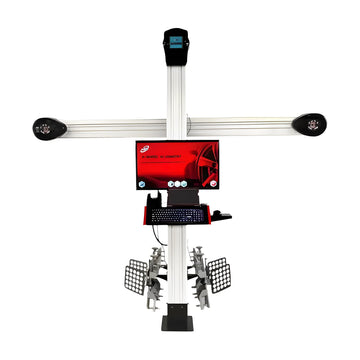
Most shops shopping for an alignment machine are choosing between two measurement approaches. Camera-based 3D systems read reflective targets clamped to the wheels from a camera beam, so no electronics hang on the wheel. The 3D and 5D machines here include the Katool KT-5DA, which uses real-time camera imaging under computer control, the KT-AV6 for cars and light commercial vehicles, the AV533 with dual cameras, and the KT-AV651, a mobile 3D unit built to work with 2-post and scissor lifts. The KT-AV9 takes the other approach, using four-wheel optical sensor heads that mount directly to the wheels.
Choose on bay layout more than on feature lists. A fixed camera beam wants a dedicated alignment bay with a level, properly anchored rack. A mobile column suits a shop that aligns a few vehicles a week and needs the bay back for other work. Sensor-head systems tolerate irregular bay geometry but add clamps, batteries and charging to the daily routine. Whichever you pick, the readings are only as good as what is underneath the car: turnplates and rear slip plates, a level runway, and correct tire pressures and ride height before the first measurement. Many late-model vehicles also require ADAS sensor recalibration after an alignment, so check the OEM service procedure before you quote the job.
Tire Changers: Passenger, Leverless and Hydraulic Truck Machines
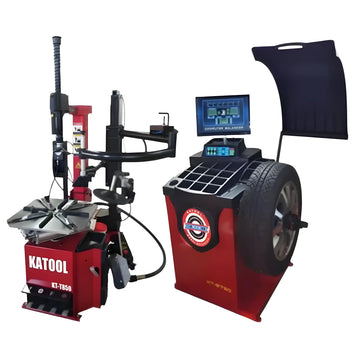
The passenger and light commercial side of the catalog centers on the Katool KT-T830, KT-T835, KT-T850, KT-T855 and KT-T900. The KT-T855 is a vertical press machine with a 12–24 in outer clamping range. The KT-T900 is a 2HP center post design with adjustable center post clamps, manual and foot pedal controls, a reinforced steel frame and an included pneumatic-assist bead breaker — the layout most shops want for low-profile and stiff-sidewall tires. Center post clamping holds the wheel through the center bore rather than gripping the rim edge, which is why leverless and center post machines dominate where alloy and painted finishes are common.
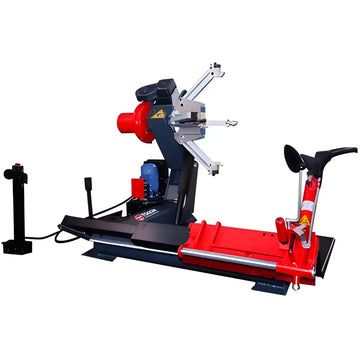
A heavy truck tire changer is a different machine: hydraulics and wheel weight capacity drive the decision. The Katool KT-TV910 hydraulic truck tire changer takes wheels up to 55" (1,400 mm) diameter and 18" (460 mm) wide at up to 838 lbs (380 kg), with a hydraulic bead breaking cylinder and a 3.0 kW pump motor. The mobile KT-308 covers 13"–26" rims and wheels up to 750 kg on 400 V three-phase power, and the KT-T260 spans 14"–42" rims. A big truck tire changer is also a floor-space and freight decision: the KT-308 alone has a net weight of 470 kg.
If you service truck and bus wheels, OSHA 1910.177 applies. It covers servicing multi-piece and single-piece rim wheels on large vehicles such as trucks, tractors, trailers, buses and off-road machines, and requires trained employees, a restraining device or cage where specified, and full deflation before demounting. It does not apply to automobile tires or to pickups and vans running automobile tires. Budget for the training and the restraining device alongside the machine, not after it.
Wheel Balancers and Tire Changer Combos
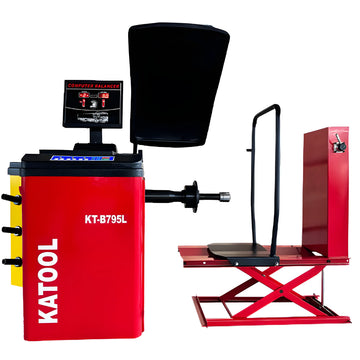
The balancers in this collection — the Katool KT-B700, KT-B750, KT-B760 and KT-B795L — appear paired with a matching changer, generally with mounting adaptors included. Combos such as the KT-T900 with KT-B760, the KT-T850 with KT-B750 and the KT-T160 with KT-B795L are the practical starting point for a new bay, because the adaptor kit that makes correct mounting possible is already in the box. One KT-T900 and KT-B760 pairing here is listed at 47" capacity.
Balancing accuracy depends less on the display than on how the wheel is mounted. Cone mounting through the center bore is fast and correct for most hub-centric wheels; flange-plate or lug-centric adaptors matter for wheels that locate on the studs, and skipping that adaptor is the most common reason a wheel "won't balance" after three attempts. Decide up front whether you also need road-force capability, which diagnoses tire and wheel runout that a plain dynamic balance cannot see. That is a different class of machine and should be specified at purchase, not added later.
Rim Straightening, Polishing and Brake Lathes
Wheel repair equipment turns a tire bay into a second revenue center. The Katool KT-WL69 is a hydraulic straightener covering 10"–22.5" rims, the KT-WL70 handles up to 26", and the KT-WL75 adds a cutting tool for refinishing work — it is built from Q235 and Q245 steel, runs on 220V and is listed with a 1 year all parts warranty. For cosmetic restoration, the KT-RPM80 rim polishing machine takes wheels up to 24" and uses a dual motor arrangement with bidirectional rotation and adjustable polishing cycles. The Katool C9372 combination brake lathe covers both rotors and drums, so one machine serves cars and older light trucks.
Know the limits before you sell the service. Straightening addresses bent flanges and radial or lateral runout; it does not repair cracks, and many wheel and vehicle manufacturers prohibit heating or straightening of specific cast and forged alloy wheels outright. Check the wheel manufacturer's published repair policy for each wheel and turn away the ones it excludes.
Shop Power, Space and Installation
Voltage is where wheel service purchases most often go wrong. This collection spans single-phase 110V combos, 220V equipment such as the KT-WL75, and three-phase machines: the KT-308 is specified at 400 V / 3 phase and the KT-TV910 at 220–240 / 380–400V, 1 or 3 phase, 50 Hz. Confirm what your panel actually supplies, including frequency, before ordering. A phase converter or a service upgrade can cost more than the difference between two machines.
Plan the physical install at the same time. Pneumatic bead breakers and clamping need shop air at the bay. Alignment equipment needs both a footprint and a level, anchored lift: the KT-5DA measures 29" x 47" x 48" and weighs 229 lbs with a 441 lb shipping weight, so receiving it means a dock or a liftgate. If you are pairing an alignment machine with a new lift, ANSI/ALI ALCTV is the standard covering automotive lift construction and testing, and ANSI/ALI ALOIM covers lift operation, inspection and maintenance, including the periodic inspection your insurer may ask to see.
What to Budget for a Wheel Service Bay
Products in this collection run from $100 to $10,449, a span that covers shop accessories at one end and complete 3D alignment systems at the other. Build the quote around three numbers you already know:
- Largest rim diameter and wheel weight you actually service, not the one you service twice a year
- Voltage, phase and air supply available at the bay
- Freight and receiving — net and shipping weights decide whether you need a liftgate
Equipment that clears those three constraints will still be the right machine in five years. Equipment chosen on sticker price alone usually is not.