Diesel Forklifts, Propane and Electric Forklifts: Start With the Power Source
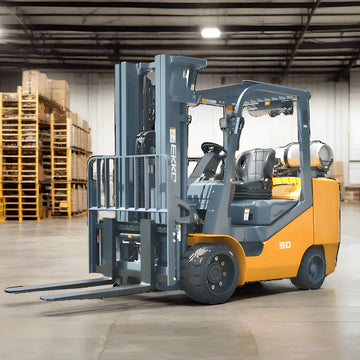
Power source is the first decision, because it sets where the truck can legally work and what it costs to run. The diesel forklift models in this collection — the EKKO EK25D (5,000 lbs), EK30D (6,000 lbs), EK35D (7,000 lbs), EK40D (8,500 lbs) and the GNT GD Series — ride on solid pneumatic tires and are aimed at yards, lumber and building-supply lots, container work and long outdoor runs where refueling takes minutes and the duty cycle never really stops. Propane covers similar ground with easier indoor tolerance: the EKKO EK30LP (6,000 lbs, 189 in. lift), EK35LP (7,000 lbs, 189 in.), EK50LP (10,000 lbs, 185 in.), the EK30TLP, EK35TLP and EK40TLP solid-pneumatic models, and the GNT GLP series. Both are internal combustion trucks, so indoor use becomes a ventilation question — OSHA regulates carbon monoxide exposure in general industry under 29 CFR 1910.1000, and 29 CFR 1910.178 limits which truck designations may operate in specific hazardous locations.
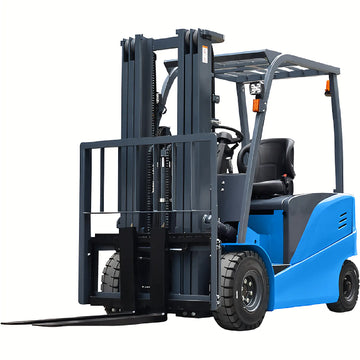
The electric forklift group is the largest part of the catalog and splits into two jobs. Four-wheel electric counterbalance trucks — EKKO EK25G-LI and EK25GT-LI (5,000 lbs), EK30GT-Li (6,000 lbs), EK35GT-Li (7,000 lbs), EK40GT-Li (8,800 lbs), EK25T-Li, EK40T-Li (8,000 lbs), plus the Eoslift CPD16, CPDS16, CPD20, CPDS20 and CPD25 — do the same work as an IC truck indoors, without engine exhaust at the point of use. Stand-up and narrow-aisle equipment is a different animal: the EKKO EK18RF (4,000 lbs, 216 in. lift, 48V), EK18RFL, the GNT GSR40-Li reach truck and GSF40Li rider (both 4,000 lbs, listed with 1.5-hour fast charging and AC drive), and the Eoslift LF15, LF20, LFC16, LFC20 and LCA15 turret truck.
| Power source | Best fit | Watch for |
|---|
| Diesel | Outdoor yards, rough ground, sustained heavy loads | Exhaust and noise restrict indoor use |
| Propane (LPG) | Yard-to-dock work, mixed indoor and outdoor | Cylinder handling, storage and ventilation |
| Electric / lithium | Indoor warehousing, narrow aisles, multi-shift | Charging space, power supply, battery type |
Capacity, Load Center and Lift Height Work as a Set
A capacity figure means nothing without its load center. Rated capacity is measured at a stated distance from the fork face — the EKKO EK50LP lists 10,000 LBS at a 24 in. load center, the Eoslift LCA15 lists 3,306.93 lbs at 23.62 in., and the LFC20 lists 4,409.24 lbs at 19.68 in. That 24 in. figure exists because the Grocery Manufacturers Association (GMA) standard pallet measures 48 by 40 inches, putting a centered load's balance point at half the pallet depth. Loads that are deeper, unevenly packed or carried on a slip sheet shift that center outward and reduce what the truck can safely lift.
Height derates capacity too. Most masts cannot lift their full rated load to full extension, and the capacity plate on the truck — not the model name — is the governing document. ANSI/ITSDF B56.1 is the safety standard covering low lift and high lift powered industrial trucks, and OSHA 29 CFR 1910.178(a)(6) requires the manufacturer's prior written approval before modifications that affect capacity or safe operation, with the nameplate updated to match. Adding a sideshifter, fork positioner or clamp counts. Get the derated figure in writing before you buy an attachment.
Site Constraints: Aisles, Floors, Tires and Docks
Measure the building before you shortlist a truck. Published dimensions decide whether a machine fits: the EK50LP lists 55.9 in. overall width, 157 in. overall length with forks and 61.8 in. wheelbase, at a 16,250 LBS service weight. That service weight matters as much as capacity, because it is what your slab, mezzanine, dock plate and trailer floor actually carry — a heavy truck plus its load can exceed ratings that a lighter machine clears easily. Confirm the rated capacity of your dock leveler and the trailer floors you load with the equipment owner.
- Aisle width — counterbalance trucks need room to turn; reach, stand-up and turret trucks are designed to work in aisles that will not accept one.
- Tires — cushion tires suit smooth indoor concrete; the solid pneumatic tires listed on the EKKO D and TLP models handle broken pavement and yard surfaces.
- Overhead clearance — check collapsed mast height against your lowest door, sprinkler heads and trailer opening, not just maximum lift.
- Charging or fueling area — OSHA 29 CFR 1910.178(g) requires provisions for battery changing and charging, including facilities for flushing spilled electrolyte, fire protection and ventilation of battery gases.
What an EE Rated Forklift Actually Is
Buyers searching for an ee rated forklift are looking at a truck designation, not a brand or a capacity class. OSHA 29 CFR 1910.178 Table N-1 lists designations for powered industrial trucks — including E, ES, EE and EX for electric trucks and D, DS, G, GS and LP for engine-powered ones — and the EE designation applies to electric trucks whose motors and other electrical equipment are enclosed. UL lists and labels electric battery-powered industrial trucks under UL 583 and internal combustion trucks under UL 558. Our product data does not identify EE-designated units, so if you are buying for a classified or dusty atmosphere, confirm the designation on the truck's own nameplate and check it against the classification of your area.
Operator Training, Inspection and Maintenance
OSHA 29 CFR 1910.178(l) requires employers to train and evaluate every powered industrial truck operator before unsupervised operation, with refresher training triggered by an accident, a near miss, unsafe operation, a change in workplace conditions or assignment to a different type of truck, and an evaluation at least once every three years. Training is truck-specific, so moving an operator from a seated counterbalance model to a stand-up reach truck is a new qualification, not a formality. OSHA 29 CFR 1910.178(q)(7) requires trucks to be examined before being placed in service and at least daily — after each shift where trucks run around the clock — and 1910.178(p)(1) requires any truck in unsafe condition to be removed from service until repaired.
Maintenance load differs by power source. Internal combustion trucks bring oil, filters, coolant and emissions service. Lead-acid electrics add watering, equalizing charges and cleaning. The lithium models here, including the GNT GSR40-Li and GSF40Li, are listed as zero-maintenance battery packs with AC drive, which removes both the watering routine and the brush wear of older DC systems.
Total Cost: What to Compare Before You Buy
Purchase price across this collection runs from $19,875 to $125,239, and the spread reflects capacity, mast height, power system and configuration rather than a simple good-better-best ladder. Build the comparison around hours, not sticker price: how many hours a day the truck runs, what energy or fuel costs at your site, whether you need a spare battery or opportunity charging to cover a second shift, what a mast or attachment adds, and what service coverage looks like locally. A lower-priced diesel forklift that idles outdoors all day can cost less to own than a lithium truck that never uses its charge cycle — and the reverse is just as true for a warehouse running multi-shift indoors. Confirm freight, offloading and any charger or attachment inclusions on the individual product page before you commit.