Choosing Between Push, Geared and Motorized Hoist Trolleys
All three trolley types ride the bottom flange of a beam and carry the hoist with them. What separates them is how the trolley is moved along that beam, and that single difference drives cost, speed and operator fatigue more than any other spec.
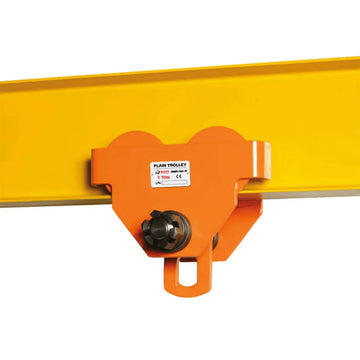
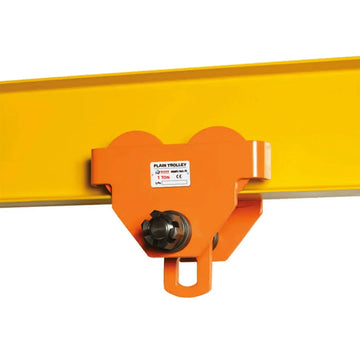
A push trolley is moved by pushing the suspended load by hand. It is the simplest and least expensive option, with no chain to manage and nothing to power. It suits short beam runs, occasional lifts, and light loads at working height where an operator can safely reach the load. Our push trolleys run from 1/2 ton to 10 ton, including the ATP-series models.
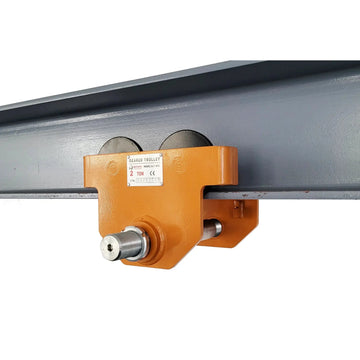
A geared trolley adds a hand chain and a gear set driving the wheels. The operator stands clear of the load and pulls the chain to traverse. That matters when the load is heavy enough that pushing it is unpleasant or unsafe, when the load is above head height, or when precise spotting is needed at a fixed drop point. Geared models here span 1/2 ton to 10 ton.
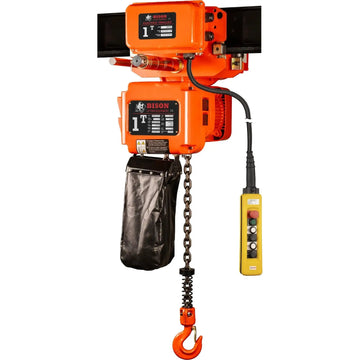
A motorized trolley traverses under power from a pendant. It earns its cost on repetitive cycles, long beam runs, and heavier capacities where hand-chain travel would dominate the work time. Bison Lifting motorized trolleys are stocked from 1/4 ton to 5 ton.
Matching Trolley Capacity to the Hoist and the Load
The trolley must be rated for at least the total suspended weight: the load, the rigging, and the hoist itself. Buyers most often go wrong by sizing to the load only and forgetting that the hoist hangs from the trolley too. A 5 ton motorized trolley in this range is rated 5 Ton (10,000 lbs), and a 1 ton unit is rated 1 Ton (2,000 lbs) — those are the numbers to compare against your total suspended weight, not against the load alone.
Also confirm the beam and its supporting structure are rated for the combined load. The trolley concentrates that weight on a short span of flange, and the beam, not the trolley, is usually the limiting component in older buildings. ASME B30.11 covers monorails and underhung cranes and is the reference to check when a beam's rating is unknown or undocumented.
Beam Fit, Flange Width and Headroom
A trolley only works on a flange it actually fits. Before ordering, measure the beam flange width and thickness, note the beam profile, and check the tightest curve radius on the run if the beam is not straight. Adjustable trolleys are set with spacer washers to suit the flange, and the setting must leave the wheels tracking squarely without binding or excessive side play.
Headroom is the other constraint. The trolley sits between the beam and the hoist, so it adds height to the whole assembly and reduces available lift. Where the ceiling is tight, low-profile designs exist for exactly this reason — the Vestil Low Profile Manual Trollies cover 1,000 – 10,000 lb across 12 models for that situation. End stops on the beam are non-negotiable on any open-ended run.
Power, Duty Cycle and Controls on Motorized Trolleys
The Bison Lifting motorized trolleys listed here run on 115V / 230V Single Phase with 24V control voltage, so most of them can be fed from a common shop circuit rather than a three-phase service. If your building is three-phase only, the 1 Ton Three Phase Hoist + Trolley package is the one to look at.
These motorized units carry a 25% duty cycle and H3 classification. Duty cycle describes how much of a given period the motor may run under load; a 25% rating is appropriate for intermittent production work, not continuous cycling. Sizing a light-duty trolley into a continuous application is a common and expensive mistake. Practical details also matter: 15 ft power cord and 17 ft pendant cord lengths determine where the disconnect and the operator's station can sit, the pendant is rated IP65 for washdown and dusty areas, Schneider contactors handle switching, and an electromagnetic load brake holds position on stopping.
Standards, Inspection and Operator Practice
Trolleys are part of a lifting system, and the system is what gets inspected. OSHA 1910.179 sets inspection and maintenance requirements for overhead and gantry cranes and requires that operators avoid carrying loads over people. ASME B30.16 covers overhead underhung and stationary hoists, and ASME B30.11 covers the monorail and underhung crane the trolley runs on. ASME B30.9 addresses slings, and OSHA 1910.184 governs sling use — worth naming because rigging failures, not trolley failures, cause most incidents on this equipment.
Day-to-day, inspect wheels for flat spots and flange wear, verify side plates and load pins are tight and correctly pinned, confirm end stops are in place, and check that the trolley rolls freely across the full run. On motorized units, test the pendant, the brake and the emergency stop before each shift.
What Vovlift Carries
This collection holds 27 active trolleys: 25 from Bison Lifting and 2 from Vestil. Bison covers push, geared and motorized drive types across 1/4 ton through 10 ton. Vestil supplies two manual ranges made in the USA by Vestil Manufacturing with a 1-Year Limited warranty — the Quick Install Manual Trollies (QIT) in 9 models from $135.71 to $484.77, and the Low Profile Manual Trollies in 12 models from $131.63 to $806.65. The Bison 2 Ton Motorized Trolley (SKU HH-B20-T) carries a 12 month warranty.