What material handling accessories cover
Material handling accessories are the second-tier equipment that makes primary equipment usable: the drum truck that moves a 55 gallon drum out of a storage row, the wheel riser that lifts a vehicle for undercarriage work, the strapping machine that closes out a finished pallet, the chock that keeps a trailer from creeping away from a dock leveler. Because they are usually bought after the forklift, rack, or dock system is already in place, they are the easiest part of a material handling budget to under-spec. Every item in this collection is Vestil, and the models with published specification tables here are listed as made in the USA by Vestil Manufacturing with a 1-year limited warranty.
Sorting by function is more useful than sorting by price. Most of what is in this collection falls into five working groups:
| Group | Examples in this collection | First question to answer |
|---|
| Drum handling | Deluxe Tilt Back Drum Trucks (DBT), Hydraulic Drum Dumpers (HDD), Portable Drum Lifter/Rotator/Transporters, Electric Drum Pumps (FHL), Drum Positioners | Full or empty? Steel, poly, or fiber? Move it, pour it, or dump it? |
| Vehicle and wheel | Steel Wheel Risers (SWR), Aluminum Wheel Risers (ATWR), Urethane Wheel Chocks (URWC), Trailer Wheel Locks (TWL), Wheel Alignment Curbs (SWAC) | Vehicle weight, floor surface, and how the riser gets repositioned |
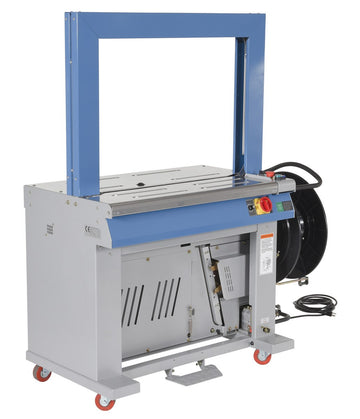
| Load containment | High Speed Strapping Machine (ASM), Semi-Automatic Pallet Probe Strapping Machine (DBA), Wall-Mounted Strapping Dispenser | Pallets per shift, and whether an operator can stay at the machine |
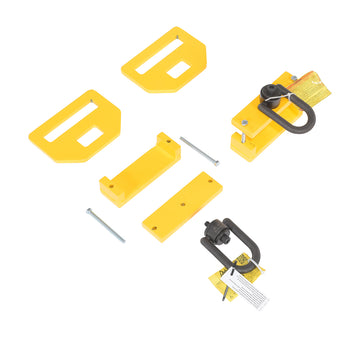
| Forklift attachments | Forklift Tie-Down Clamps (FTDC), drum gripper attachments | Effect on rated capacity and manufacturer approval |
| Waste and specialty | Pneumatic Trash (55 Gallon Drum) Compactor, Mobile Gasoline Powered Drum Crusher, Cylinder Caddies (CYL), Wheel Chair Ramps (D) | Available power and where the work happens |
Drum handling: match the tool to the drum and the task
Drum equipment splits by what you need the drum to do. A tilt-back drum truck like the DBT series moves a drum short distances on two wheels and sets it back down upright; it is a manual tool for a person, not a substitute for a lift. A hydraulic drum dumper inverts the drum to discharge contents into a hopper, bin, or mixer, which is a different frame, a different footprint, and a different price bracket. Lifter/rotator/transporters combine travel with controlled pouring. Drum pumps leave the drum where it stands and move only the liquid.
Container type drives the gripper. This collection includes poly drum options in 30 gallon and 55 gallon configurations because a poly drum's rolling hoop does not behave like a steel drum's chime under a clamp. Contents matter too: OSHA 1910.106 governs the storage and handling of flammable liquids, including bonding and grounding requirements when transferring Class I liquids, so confirm a pump and its motor are appropriate for the liquid before it goes into service. Where a drum lifter is suspended from a crane or hoist rather than carried on a truck, ASME B30.20 is the standard that addresses below-the-hook lifting devices.
Wheel risers, chocks and vehicle restraint
Wheel risers raise a vehicle's wheels so a technician can work at a usable height without a full lift. The Steel Wheel Riser with Central Fork Pocket line is the deepest option here, with 17 models running from $344.00 to $3,104.31 — the fork pocket lets a lift truck reposition the riser instead of dragging it. Related options include a pickup loop (model SWR-CPL, $344.00) for moving risers with a hoist or hook. Aluminum risers weigh less and are easier for one person to reposition by hand; steel generally costs less per pound of capacity and takes more abuse in a shop environment.
Chocks and locks are the cheap items with the largest consequences. OSHA 1910.178(k)(1) requires that the brakes of highway trucks be set and wheel chocks placed under the rear wheels before a powered industrial truck boards them, which is why urethane chocks and trailer wheel locks belong on a dock order rather than in a maintenance drawer. Wheel alignment curbs solve a different problem: repeatable parking position, so vehicles stop where the workflow expects them to.
Strapping and load containment
Strapping equipment scales with throughput. Hand strapping off a wall-mounted dispenser suits low, irregular volume. A semi-automatic table machine such as the S-2001 (30 in.) has an operator feed the strap around the load and the machine tension, seal, and cut. A pallet probe machine such as the DBA-130 at $6,375.95 feeds strap around a pallet load without tipping or restacking it. At the top of the range, the ASM-3123 automatic high speed strapping machine at $8,562.62 is a line machine, not a bench tool. Secured loads also support the general storage requirements in OSHA 1910.176, which addresses stable, secure storage of materials.
Forklift attachments and rated capacity
Attachments are the accessory category with a hard compliance edge. OSHA 1910.178(a)(4) states that modifications and additions affecting capacity and safe operation are not to be performed without the manufacturer's prior written approval, and that capacity, operation, and maintenance instruction plates, tags, or decals must be changed accordingly. ANSI/ITSDF B56.1 is the safety standard for low lift and high lift trucks and addresses attachment and capacity marking as well. In practice, an attachment adds weight and pushes the load center forward, so the truck's net capacity with the attachment installed is lower than the bare nameplate figure. Get the derated figure from the truck manufacturer in writing before ordering. Separately, OSHA 1910.178(l) requires operator training and evaluation for powered industrial trucks, and attachment-specific handling belongs in that training.
How to choose: power, duty cycle and site
Start with the power available at the point of use. This collection includes manual, pneumatic, electric, and gasoline-powered equipment, plus hydraulic drum power unit options in 12V DC and 115V AC. A pneumatic drum compactor needs shop air with enough recovery for the cycle rate; a gasoline-powered drum crusher needs outdoor operation or engineered ventilation. Then look at duty cycle honestly — equipment sized for occasional use fails early on a per-shift schedule.
After that, check the physical fit: floor surface and slope, aisle width for a turning drum truck, ceiling height for a dumper at full tilt, and where the accessory parks when it is not in use. Wheelchair ramps are a good example of a spec that is defined off-site: the ADA Standards for Accessible Design set a maximum 1:12 running slope for ramps, so the required ramp length follows directly from the rise you are covering. Finally, confirm what ships with the unit and what is a separate option — grippers, power units, pickup loops, and drum-type adapters are frequently ordered as add-ons.