Graders for precision earthmoving and site preparation: what these attachments actually do
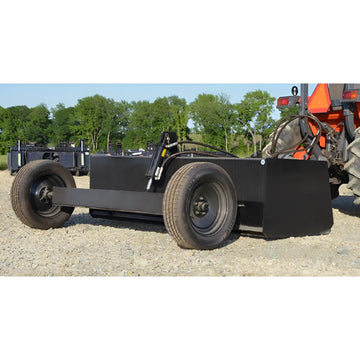
The graders on this page are attachment-style grading tools, not self-propelled motor graders. A land leveler or land plane is carried by a compact tractor or mini skid steer and uses a rigid frame with fixed blades to shave high spots and carry that material forward into the low spots ahead of it. Because the frame contacts the ground at more than one point, it averages the surface it passes over instead of following every dip the way a single rear blade does. That is the entire reason these tools exist: repeatability. Two or three passes in alternating directions will flatten a gravel drive, a riding arena, an equipment pad, a paddock or a food plot far more consistently than a box blade in inexperienced hands.
They are finishing and maintenance tools first. Neither unit here is meant to move large volumes of virgin soil or excavate; that is bucket, dozer or excavator work. Bring a grader in after the rough shaping is done, or run it as recurring maintenance on a surface that has already been built and compacted.
Tractor land leveler vs. mini land plane: choose by carrier machine first
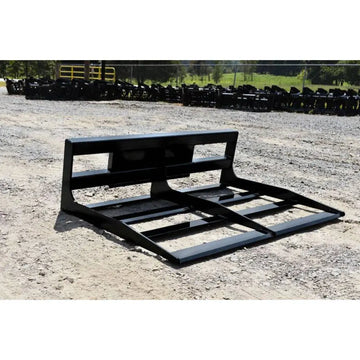
The first filter is not width or price — it is what sits in your yard. The Loflin Fabrication Mini Land Plane is built for mini skid steers and lists compatibility with Toro Dingo, Bobcat MT50 and other mini skid steer models, so it suits landscape crews, arena maintenance and tight residential lots where a tractor cannot turn around. The Loflin Fabrication Tractor Land Leveler is a tractor-mounted attachment with a hydraulic lift and an adjustable cutting angle, which is the configuration you want for longer driveways, lanes and larger open acreage where pass count drives your labor cost.
| Spec | Tractor Land Leveler | Mini Land Plane |
|---|
| Mount | Tractor-mounted attachment | Toro Dingo, Bobcat MT50, other mini skid steers |
| Working width | 84" to 96" | 49" |
| Steel | 7-gauge (3/16") plate | 3/8" frame, 3" x 3" square tubing |
| Cutting edge | Reinforced, replaceable | 1/2" thick x 4" wide |
| Adjustment | Adjustable cutting angle, hydraulic lift | Custom sizes available |
| Options | Scarifier bars and transport wheels on some models; optional powder-coated finish | Powder-coated |
Sizing a grader: working width, steel thickness and stability
Working width should exceed your carrier machine's track or tire width so the tool cuts ground the machine has not already packed down, and so you are not steering to keep the wheels off fresh material. Beyond that, wider is faster but demands more traction and more weight to hold the cut — a 96" leveler behind an underpowered tractor will ride up over material instead of shearing it. At 49", the Mini Land Plane is deliberately matched to mini skid steer footprints rather than sized for coverage.
Steel thickness tells you the duty cycle. The Tractor Land Leveler uses 7-gauge (3/16") plate with a reinforced, replaceable cutting edge; the Mini Land Plane uses a 3/8" frame on 3" x 3" square tubing with a 1/2" thick by 4" wide cutting edge. Replaceable edges matter more than most buyers expect: on abrasive crushed stone, the edge is the wear item, and a tool designed around swapping it will outlast one where the wear surface is welded into the frame.
Grading technique that produces a flat, draining surface
Set the tool to skim, not dig. Take shallow cuts and let the frame length do the averaging; forcing depth on the first pass loads the machine, tears out material you will then have to redistribute, and leaves the ripple pattern you were trying to remove. Alternate pass direction and offset each pass so you are not tracking the same wheel paths. On potholed gravel, break the compacted edges of the holes first — scarifier bars are available on some Tractor Land Leveler models — because material planed across an intact pothole rim will not bond and will pump back out under traffic.
Grade toward drainage, not just toward flat. Water standing on a surface is what destroys it, so establish fall away from structures and keep the crown or cross-slope you cut. Before any work that disturbs soil, use the national 811 "Call Before You Dig" service to have buried utilities located. For larger projects, the EPA's NPDES Construction General Permit applies to construction activity disturbing one or more acres and requires erosion and sediment controls.
Safety, maintenance and operator considerations
Most of the risk in this category belongs to the carrier machine, not the attachment. OSHA 29 CFR 1928.51 requires rollover protective structures and seat belts on covered agricultural tractors, and OSHA 29 CFR 1928.57 requires guarding of power take-off shafts and other power transmission components on farm field equipment. On construction sites, OSHA 29 CFR 1926.602 addresses earthmoving equipment, including seat belt requirements. Attachment mounting hardware is defined by hitch standards — ASABE S217 covers three-point free-link attachment of implements to agricultural wheel tractors — so confirm your hitch category or mini skid steer plate interface before ordering.
Maintenance is straightforward: inspect and rotate or replace the cutting edge before it wears into the frame, check mounting pins and hardware for elongation after heavy use, and keep hydraulic connections clean on lift-equipped units. Powder-coated finishes hold up better than paint on equipment stored outdoors, and both models offer that finish. Store the tool off bare dirt if you can.
Cost, and what buyers get wrong
Pricing in this collection runs from $1,025 to $3,249, and the spread reflects size and carrier machine rather than a good-better-best tier. The most common mistake is buying a grading attachment to do excavation — expecting a land plane to cut a pad out of a slope or remove stumps and roots. The second is buying wider than the tractor can hold in the cut, which produces a tool that floats instead of shears. The third is skipping the drainage question entirely and regrading the same driveway every season. Match the tool to your machine, keep cuts shallow, and grade for water first.